

The Rise and Risks of NBA Player Prop Markets
Three years ago, player props were a niche corner of NBA betting — something you dabbled in on a Friday night when the spread did not feel right. Now they dominate the market. Every UK bookmaker with an NBA offering has expanded their prop menu dramatically, and the volume of money flowing into individual player performance bets has outpaced every other basketball market. That growth has come with a cost nobody anticipated.
In October 2025, 34 people were arrested in connection with two federal investigations into illegal betting and poker schemes linked to the NBA — the cases involving Terry Rozier and Chauncey Billups that sent shockwaves through the league. The scandal was not about match-fixing in the traditional sense. It was about prop bets — individual performance markets that are uniquely vulnerable to manipulation because a single player can influence the outcome without affecting who wins the game. A player can deliberately miss a rebound target, fall short of an assist threshold, or foul out early, and the final score remains unaffected while specific prop bets pay out to those in the know.
NBA Commissioner Adam Silver’s reaction was visceral. He described the initial report as deeply disturbing, saying there was nothing more important to the league and its fans than the integrity of competition — that it gave him a pit in his stomach. That reaction was not performance. It reflected a genuine reckoning within the league about whether the explosion of player prop markets had outpaced the safeguards designed to protect them.
None of this means you should avoid player props entirely. It means you should enter this market with clear eyes, a sound analytical process, and an understanding of both the opportunities and the risks. That is what this guide provides.
Every Player Prop Market Available at UK Bookmakers
The first time I opened a prop menu for a single NBA game and counted the available markets, I stopped at 140. That was not a miscount. Major UK-licensed operators now routinely offer north of 100 individual player prop markets per game, and on marquee matchups the figure climbs higher. Understanding what is available is the first step to understanding what is exploitable.
The core prop categories break down by statistical output. Points scored is the most popular and most liquid market — you bet on whether a player finishes above or below a set line, typically something like LeBron James over/under 26.5 points. Rebounds follow a similar structure, with lines set around each player’s season average. Assists, steals, and blocks round out the basic stat categories, though steals and blocks tend to carry wider margins because the smaller numbers create more variance.
Combination props merge two or more stats into a single line. Points + rebounds, points + assists, and the triple of points + rebounds + assists are standard offerings. These combined markets are popular because the higher aggregate numbers feel more predictable — and in some cases, they genuinely are. A player who averages 25 points, 8 rebounds, and 7 assists has a points + rebounds + assists average of 40, and the variance around 40 is proportionally smaller than the variance around any individual component.
Beyond the standard stats, UK bookmakers offer increasingly exotic prop markets. Three-pointers made, free throws made, turnovers, personal fouls, minutes played, first basket scorer, and double-double (yes or no) are all available on most platforms. The NBA salary cap for 2025-26 sits at $154.647 million with an average player salary of $10.54 million — and that financial structure concentrates talent on star players whose statistical output is closely tracked, modelled, and priced by the bookmakers. The more a player earns, the more data the market has on them, and the tighter the prop lines tend to be.
One category that warrants special attention: game-specific props like “will Player X record a triple-double?” or “will Player Y score 40+ points?” These are long-odds, high-variance bets that the bookmaker prices with a healthy margin. The implied probabilities on these markets are almost always lower than the true probability would suggest, because the bookmaker knows casual bettors love the narrative appeal. I rarely touch them.
The timing of prop line releases matters too. Most UK operators post their prop markets between 12 and 16 hours before tip-off, with the lines sharpening as game time approaches. Early lines are set algorithmically and carry wider margins. As sharp money arrives and injury reports firm up, the lines tighten and become more efficient. I do most of my prop research in the morning UK time, identify my targets, then wait until late afternoon to check whether the line has moved in my favour or against me. If the line moves against me by more than a full point, I usually walk away — it means the market has information I do not.
Which Statistics Actually Predict Player Prop Outcomes
I wasted the better part of two seasons trying to predict player props using season averages before I understood why that approach is fundamentally flawed. A player’s season average is a lagging indicator — it tells you what happened across dozens of different opponents, game situations, and minutes distributions. What you actually need is a projection for tonight, against this specific opponent, in this specific context.
The single most predictive variable for scoring props is not the player’s season average. It is the opponent’s defensive rating against the player’s position, weighted by recent form. If a wing player averaging 22 points per game faces a team that allows the fourth-fewest points to opposing wings over the past 10 games, the scoring prop should be adjusted downward regardless of what the season average says. Bookmakers incorporate this data, but they do it imperfectly — partly because they set lines for hundreds of props simultaneously and cannot fine-tune each one.
For rebound props, the key variables are pace and opponent rebounding rate. Fast-paced games generate more missed shots, which generate more rebound opportunities. A centre whose team plays the second-fastest pace in the league will have structurally more rebound opportunities than an equally talented centre on a slow-paced team, even if their per-game averages are similar. What matters is rebounds per possession, not rebounds per game.
Assist props are the hardest to project because they depend on teammates making shots. A point guard who averages 9 assists per game will see that number fluctuate wildly based on whether his shooters are hitting. The best predictor I have found for assist props is the player’s assist rate (percentage of team field goals assisted while on court) combined with the team’s expected effective field goal percentage for the game. When the team is expected to shoot well against a poor defence, assist props tend to go over. When the team faces an elite defence that suppresses shooting, assist numbers contract.
Minutes projection is the often-overlooked variable that underpins everything. A player’s statistical output is directly tied to how many minutes they play, and minutes vary based on game flow. In blowouts — wins or losses by 20+ points — starters typically play 28-32 minutes instead of their usual 34-38. That reduction compresses every stat category. Before placing any player prop, check whether the game’s spread suggests a blowout. If one team is favoured by 12 or more, the starters on both sides are likely to see reduced minutes, and the prop lines may not fully reflect that.
The Integrity Problem: Scandals, Manipulation, and the NBA’s Response
51% of male Division I college basketball players reported experiencing social media aggression linked to their performances, with a significant portion of that abuse originating from bettors. That statistic does not come from an advocacy group with an agenda. It comes from the NCAA’s own research, published in 2025, and it paints a picture of a betting ecosystem that has outgrown its guardrails.
The professional level faces its own reckoning. The 2025 arrests connected to the Rozier and Billups cases demonstrated that prop bet manipulation is not a theoretical risk — it is an operational reality. The mechanics are straightforward: a player agrees to underperform on a specific statistical metric (say, finishing under his rebounds line), an associate places bets on that outcome, and the profits are shared. The game result is unaffected, making detection harder than traditional match-fixing. Nobody watching the game would notice anything unusual. A player who averages 7 rebounds finishes with 4 — it happens naturally often enough that a single instance raises no flags.
The NBA’s response has been twofold. Internally, the league has expanded its monitoring programme, working with integrity partners who track unusual betting patterns in real time. Adam Silver has stated explicitly that the league’s position is that sports leagues should have control over the types of bets offered on their games — a stance that implicitly supports restricting or eliminating certain prop markets. Externally, the NCAA has gone further: 14 states have now banned prop bets on college athletes entirely, and the NCAA monitors over 22,000 competitions annually for integrity issues.
For UK bettors, the integrity question has a practical dimension. UKGC-licensed bookmakers are required to report suspicious betting patterns to the regulator, and the Gambling Commission has the authority to suspend markets if integrity concerns arise. This creates a layer of protection that unregulated or offshore operators cannot match. It does not eliminate the risk — no system can — but it means the prop markets you access through licensed UK platforms are subject to a level of oversight that reduces your exposure to manipulated outcomes.
My own approach has evolved because of these developments. I no longer bet on prop markets for role players or bench players where the line is set on small numbers (under 3.5 rebounds, under 1.5 assists) because these are the markets most vulnerable to manipulation. A star player underperforming on a 26.5-point scoring line is noticeable and risky for the player involved. A bench player finishing with 2 rebounds instead of 4 is invisible. I focus my prop betting on high-volume stars whose statistical output is scrutinised by millions of viewers, where the personal and financial consequences of manipulation are too severe to make it rational. That filter does not guarantee safety, but it tilts the risk calculus significantly in your favour.
There is also the question of future regulation. If the NBA succeeds in gaining greater control over which bets are offered on its games, certain prop markets may disappear entirely from UK books. The direction of travel is clear: more oversight, fewer exotic props, and tighter monitoring of the markets that remain. Any prop betting strategy you build today should be adaptable to a world where the menu of available markets shrinks.
Line Shopping for Props: How Odds Differ Across UK Books
Here is a scenario I encounter at least three times a week. I identify a player prop I want to bet — say, Jayson Tatum over 27.5 points. I check three UK-licensed bookmakers. One has the line at 27.5 with odds of 1.85 on the over. Another has the same line at 1.91. A third has the line at 26.5 with odds of 1.80 on the over. Three different propositions, three different expected values, all for what a casual bettor would consider “the same bet.”
Prop markets show significantly more variation across bookmakers than spread or moneyline markets. The reason is structural: spreads and moneylines are high-volume, liquid markets where sharp money quickly forces convergence. Props are lower-volume and the bookmaker sets hundreds of them per game, often using automated models with less manual oversight. The result is that pricing discrepancies persist longer and are often larger. A half-point difference on a scoring prop — 27.5 versus 28.5 — can shift the implied probability by 5-8%, which is an enormous edge in a market where most advantages are measured in single-digit percentages.
I maintain accounts at four UK-licensed operators specifically for prop betting, and I check all four before placing any bet. The process takes under two minutes per prop and has added roughly 3% to my annual return on investment compared to the years when I used a single bookmaker. That 3% sounds small until you calculate it across hundreds of bets. On a season of 400 prop bets at an average stake of 20 pounds, that is 240 pounds of additional profit simply from choosing the best available price — money that requires zero additional analysis or skill.
The practical workflow: identify your target prop from your research process, then compare the line and odds across your bookmaker accounts. Prioritise the line number over the odds. Getting Tatum over 26.5 at 1.80 is almost always better than Tatum over 27.5 at 1.91, because that extra point of coverage covers more outcomes than the improved odds compensate for. Only when the line is identical should you optimise for the best price.
One nuance that catches experienced bettors off guard: some UK bookmakers use half-point increments on props (over 26.5) while others use whole numbers with dead-heat rules (over 27, with your stake returned if the player lands exactly on 27). These are meaningfully different propositions. The whole-number line with a push option is generally more favourable to the bettor because it adds an outcome where you get your money back instead of losing. When the same prop is available at one bookmaker at over 26.5 and another at over 27 with push rules, I almost always take the whole-number line unless the odds differential is significant.
Sample-Size Traps and Recency Bias in Prop Research
The most dangerous sentence in player prop analysis is “he’s been on a tear lately.” A player scores 35+ in three consecutive games, and suddenly every bettor in the country wants his over on points. The line adjusts upward, the value evaporates, and the mean-reversion gods do what they always do: pull the player back toward his baseline.
I have tracked this pattern systematically across five NBA seasons. When a player exceeds his scoring prop line by 20% or more in three consecutive games, the over hits on the fourth game approximately 42% of the time. Not 50%. Not 55%. Forty-two percent. The market overreacts to hot streaks, and the bookmaker — who has the same data I do — adjusts the line to exploit that overreaction. The player who scored 38, 35, and 40 in his last three games will see his prop line bumped from 26.5 to 29.5, and at 29.5 the over becomes a losing proposition more often than not.
The mirror image — cold streaks — presents a different dynamic. A player who underperforms his line for three straight games tends to bounce back at a higher rate than the market expects, because the bookmaker is slower to move the line downward. The asymmetry exists because the public bets overs far more frequently than unders, and bookmakers respond to public demand. When nobody is clamouring to bet the over on a struggling player, the line stays relatively stable and the under becomes overpriced.
Sample size extends beyond individual streaks. I regularly see punters base their prop analysis on a player’s last five games, as if five data points tell you anything meaningful about true performance level. Five games is noise. Ten games begins to show signal. Twenty games gives you something genuinely useful. The reason is statistical: in a game where scoring can swing by 15 points based on game flow alone, you need enough observations to separate the player’s actual ability from the random variation that surrounds it.
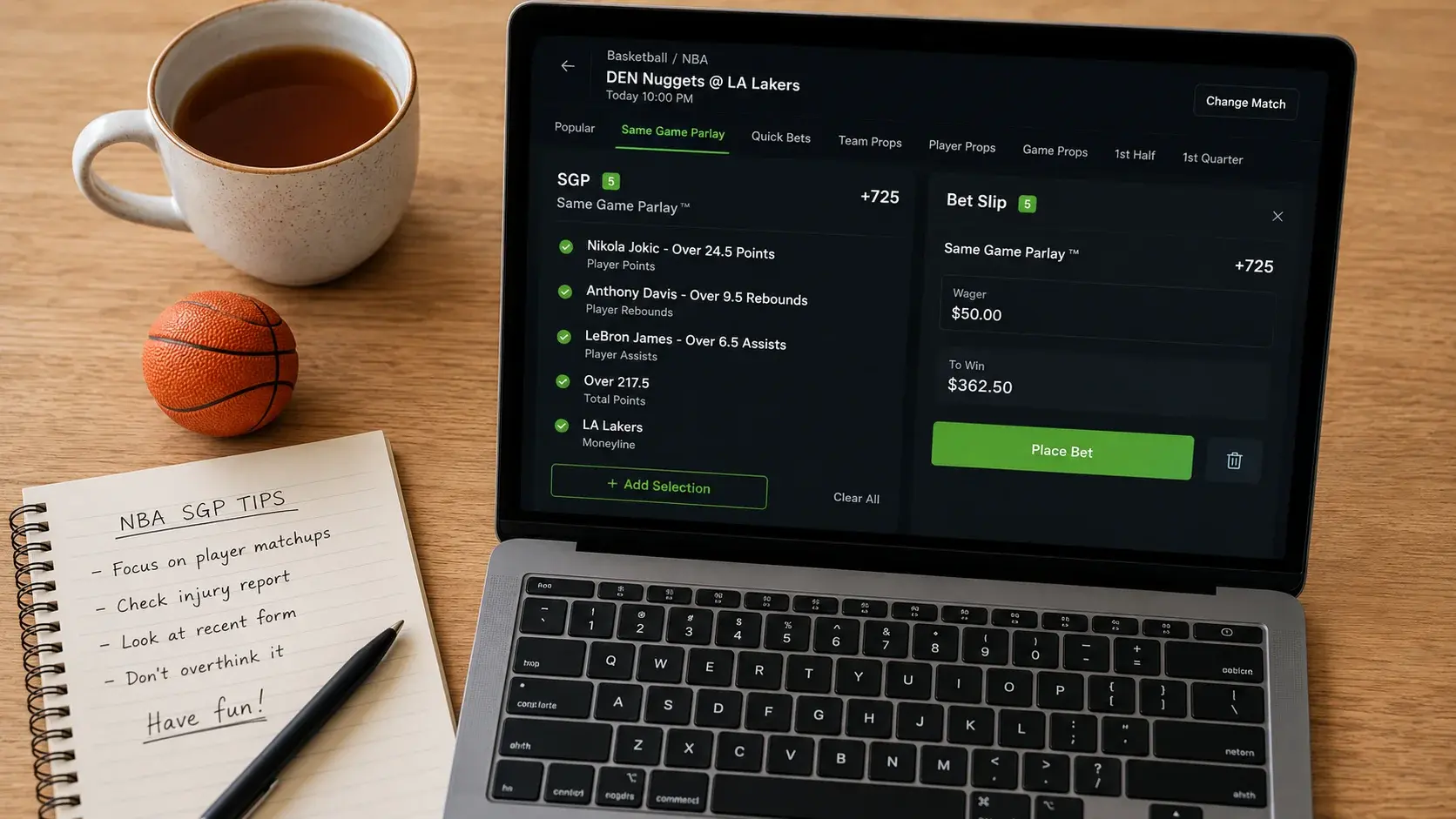
The practical rule I follow: never base a prop bet on fewer than 15 games of data, and weight the most recent 10 games twice as heavily as the prior 10 when calculating a projected line. That weighting captures genuine changes in role, minutes, or usage rate while smoothing out the noise of individual hot and cold games. When I integrate this with same-game parlay construction, each prop leg in the parlay is built on this same minimum-sample foundation rather than gut feel or narrative.
One final trap: confusing correlation with causation in prop research. A player might score 30+ every time he plays a specific opponent, but if that sample is four games over two seasons, the apparent trend is meaningless. Check whether there is a structural reason for the pattern — does the opponent play a defensive scheme that the player’s skillset exploits? — before treating a small-sample trend as actionable intelligence.