
Analyzing the Bookmaker’s Edge in NBA Parlays
I once hit a five-leg NBA accumulator that paid out just over four hundred pounds from a ten-pound stake. It felt incredible — for about an hour. Then I calculated how much I had spent on five-leg accumulators that season and realised the one winner had not even covered the losses. That is the accumulator trap in a single anecdote: the wins are memorable, the losses are invisible, and the maths always favours the house.
The average win rate for US bookmakers hit a record 9.7% in 2025. Parlays contribute disproportionately to that margin because each additional leg compounds the bookmaker’s edge. A single bet with a 4.5% margin is manageable. Multiply that margin across three, four, or five legs, and the effective house edge balloons to levels that make long-term profitability nearly impossible for all but the most disciplined bettors.
None of this means you should never place an NBA accumulator. It means you should understand exactly what the maths does to your money before you decide whether the entertainment value justifies the cost. Treat the next few sections as a stress test for your accumulator habit — if you can read the numbers and still enjoy the format, at least you are walking in with open eyes.
Parlay Mathematics: How Combined Odds Multiply Risk
The appeal of parlays is simple: bigger payouts from small stakes. The reality is less glamorous once you run the numbers.
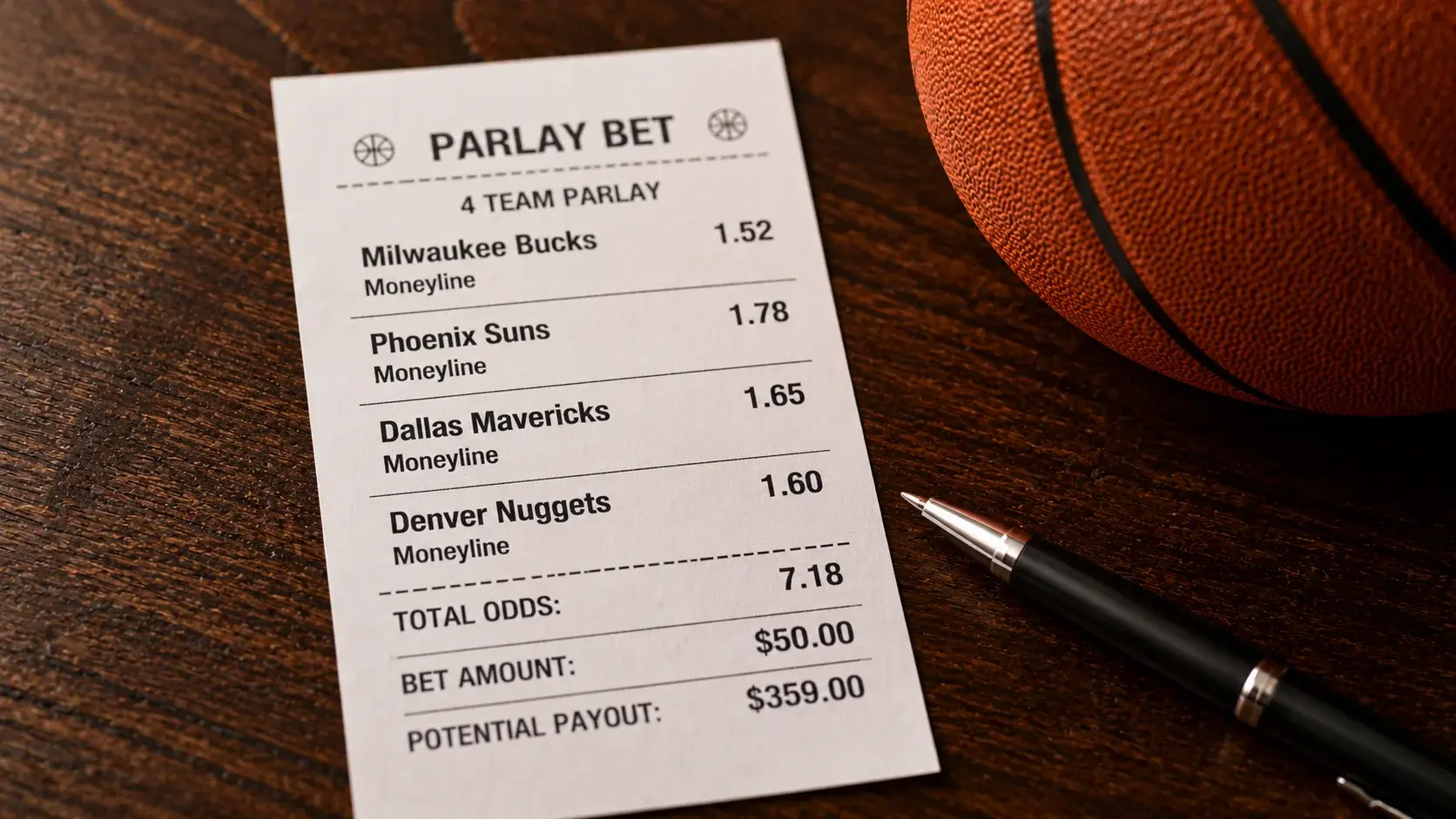
Take two NBA moneyline favourites at 1.60 each. Individually, each implies a 62.5% win probability. As a two-leg accumulator, the combined odds are 1.60 x 1.60 = 2.56, and the combined probability of both winning is 0.625 x 0.625 = 39.1%. You have gone from a positive-expectation single bet to a coin-flip-minus scenario in one click.
Add a third leg at 1.60 and the combined odds reach 4.096, but the combined win probability drops to 24.4%. You now lose three-quarters of the time. A fourth leg pushes you to 15.3%, and a fifth to 9.5%. At five legs, you are winning roughly one in ten attempts — and the payout needs to exceed 10x your stake just to break even, before the overround even enters the equation.
What makes this especially punishing is that 60% of UK gambling industry profits come from just 5% of customers who are problem gamblers or at-risk. Accumulators, with their low stake and high-potential-return structure, are particularly attractive to bettors chasing losses or seeking emotional highs. The format is designed to be addictive, and understanding the maths is the first step toward using it responsibly rather than reactively.
Leg Count: Sweet Spots and Danger Zones
After years of tracking my own results, I have settled on a personal policy: two legs maximum for anything I consider a serious bet, three legs for occasional high-conviction plays, and never more than three.
The two-leg parlay is the sweet spot for most NBA bettors. It boosts your potential return without catastrophically reducing your win probability. Two well-researched NBA picks at 1.70 each combine to 2.89 — a meaningful uplift from either single bet — while maintaining a combined win probability above 34%. You lose twice as often as you win, but the payout compensates if your individual pick accuracy is strong enough.
Three legs push you into entertainment territory. The maths works only if your individual pick accuracy is genuinely above 60%, which most bettors overestimate dramatically. I allow myself one three-leg accumulator per week during the NBA season, capped at a fixed stake that represents less than 2% of my bankroll. It is a controlled indulgence, not a strategy.
Four legs and above are, statistically speaking, donations to the bookmaker. The combined margin at four legs typically exceeds 15%, and at five legs it can reach 20% or more. You need to hit at an extraordinary rate to overcome that drag, and sustained extraordinary performance in NBA betting is exceptionally rare. If someone tells you they consistently profit from five-leg NBA accumulators, ask to see the spreadsheet.
One structural alternative worth considering: instead of a four-leg parlay, place two separate two-leg parlays. You get similar action, similar engagement with multiple games, but your risk is distributed rather than concentrated. If one double loses and the other hits, you break close to even rather than losing everything. It is a small change in format that produces a meaningful change in long-term results.