

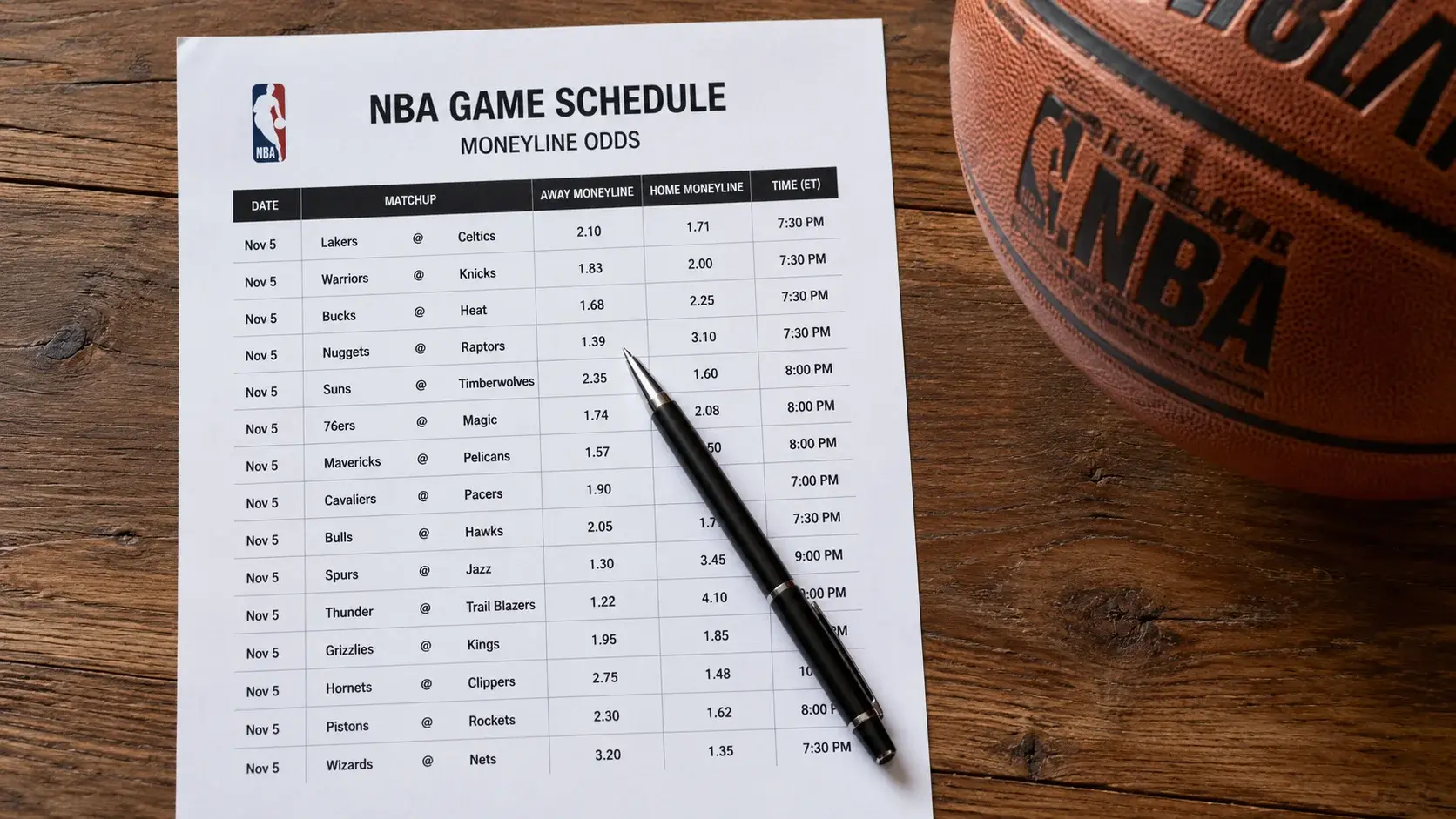
Calculating Immediate Payouts in NBA Moneyline Bets
The first NBA bet I ever placed was a moneyline on the Golden State Warriors in 2014. I did not know what a spread was, had never heard of player props, and could not have explained the difference between an accumulator and a lunch order. But I knew Golden State were good, and I wanted to bet on them winning. That is the moneyline in its purest form — pick the team you think wins, and if they do, you get paid.
No point spreads, no margins of victory, no statistical thresholds. The moneyline asks a single question: who wins this game? The global sports betting market reached $100.9 billion in 2024 and is projected to more than double by 2033, and moneyline bets remain the gateway for most new entrants. Every NBA bettor starts here, and plenty of experienced ones never leave.
What makes the moneyline deceptively interesting is the pricing. A team’s decimal odds encode the market’s assessment of their win probability, and the gap between favourite and underdog pricing creates different risk-reward profiles depending on the matchup. A blowout mismatch prices differently from a coin-flip rivalry game, and knowing when each profile offers value is where the real skill sits.
Moneyline Mechanics: Favourites, Underdogs, and Decimal Pricing
In decimal format — the UK default — moneyline odds work like this. The favourite carries odds below 2.00, and the underdog sits above 2.00. The lower the favourite’s number, the stronger the market believes they are. Odds of 1.20 imply an 83% chance of winning. Odds of 1.80 imply roughly 56%. A true coin-flip game would price both sides at 2.00, though in practice the overround ensures you never see exactly that.
Here is a worked example. The Denver Nuggets host the Indiana Pacers. The moneyline reads: Nuggets 1.45, Pacers 2.90. You believe Denver win this game, so you stake twenty pounds on the Nuggets at 1.45. If Denver win — by one point or fifty — you receive 20 x 1.45 = 29 pounds. That is nine pounds profit. If you fancy the upset, twenty pounds on Indiana at 2.90 returns 58 pounds — a 38-pound profit from the same stake.
The asymmetry is the key. Favourites pay less but win more often. Underdogs pay more but lose more often. Over an 82-game season with 1,230 regular-season contests, the NBA Finals in 2025 drew an average of 10.2 million US viewers per game, with Game 7 pulling 16.35 million — confirming that the sport generates enough data to build meaningful models around moneyline value. The question is never simply “who wins?” but “does this price adequately reflect how often they win?”
When Moneyline Beats the Spread — and When It Doesn’t
A question I get asked constantly: should I just take the moneyline instead of messing about with spreads? The answer depends on the price gap and your confidence in the outright result.
Moneyline shines on moderate underdogs — teams priced between 2.50 and 4.00. At these odds, you do not need the team to win often for the bet to be profitable. If you back a 3.00 underdog and they win just 35% of the time, you are making money. Finding those spots — rest-advantage games, early-season schedule quirks, letdown spots after big wins — is where moneyline betting rewards patient analysis.
Moneyline struggles with heavy favourites. A team priced at 1.15 needs to win roughly 87% of the time to break even. NBA teams simply do not win at that rate consistently, even the very best squads in league history. Adam Silver himself has acknowledged that when sports betting was legalised, the league was not at the negotiating table — deals were struck between states and gaming operators. That disconnect means pricing sometimes reflects public perception more than on-court reality, and heavy favourite moneylines are where this distortion is most dangerous.
The spread levels the playing field by giving the underdog a head start. On a night when the favourite is priced at 1.12 on the moneyline but -10.5 on the spread at 1.91, the spread offers far better value for backing the favourite, because you are getting nearly double the payout for accepting a condition — the team must win by 11 or more — that your analysis might support. Conversely, if you believe the underdog has a genuine chance of winning outright, the moneyline often pays better than taking them on the spread.
Combining Moneylines in NBA Accumulators
This is where moneyline bets become both exciting and dangerous. Combining two or three NBA moneyline picks into an accumulator multiplies the odds and the potential payout — but also multiplies the probability of losing.
Take three moderate favourites at 1.60, 1.55, and 1.70. Individually, each has an implied win probability around 59-63%. Combined into an accumulator, the odds multiply to 4.216, and your ten-pound stake returns 42.16. But the combined probability of all three winning drops to roughly 23%. Three-quarters of the time, you lose your stake entirely.
I use NBA moneyline accumulators sparingly and only in specific situations: when I have strong conviction on two or three games and the individual moneyline prices are in the 1.50-1.80 range. I avoid accumulators with heavy favourites below 1.30 — the individual returns are too thin to justify the compounded risk, and one upset wipes everything. I also avoid four-leg and five-leg accumulators entirely. The maths become punitive beyond three selections, and the bookmaker’s margin compounds with every additional leg.
The most disciplined approach is to treat accumulators as a small portion of your total NBA betting — entertainment plays, not core strategy. Your regular moneyline bets should be flat-staked singles where the maths actually work in your favour over a full season.