
Strategic Hedging in Long-Term NBA Futures
The first NBA futures bet I ever placed was a championship outright on the Milwaukee Bucks at 12.00 in October. They won the title that season, and I collected a tidy profit in June. What I did not appreciate at the time was the opportunity cost — that money sat locked in a bookmaker’s account for nine months, unavailable for the hundreds of individual game bets I could have placed throughout the season. Futures betting is not just about picking winners. It is about deciding whether tying up capital for months is worth the potential return.
The NBA set all-time attendance records across three consecutive seasons through 2025-26, surpassing 22.18 million fans. That engagement drives an enormous futures market — UK bookmakers open NBA championship odds before the previous season’s Finals are even finished. The 2025-26 season drew 170 million viewers across US broadcast and streaming platforms, and every one of those viewers represents potential futures betting interest. The market is deep, liquid, and — for those who time their entries correctly — exploitable.
Championship Outright Markets and Timing Your Entry
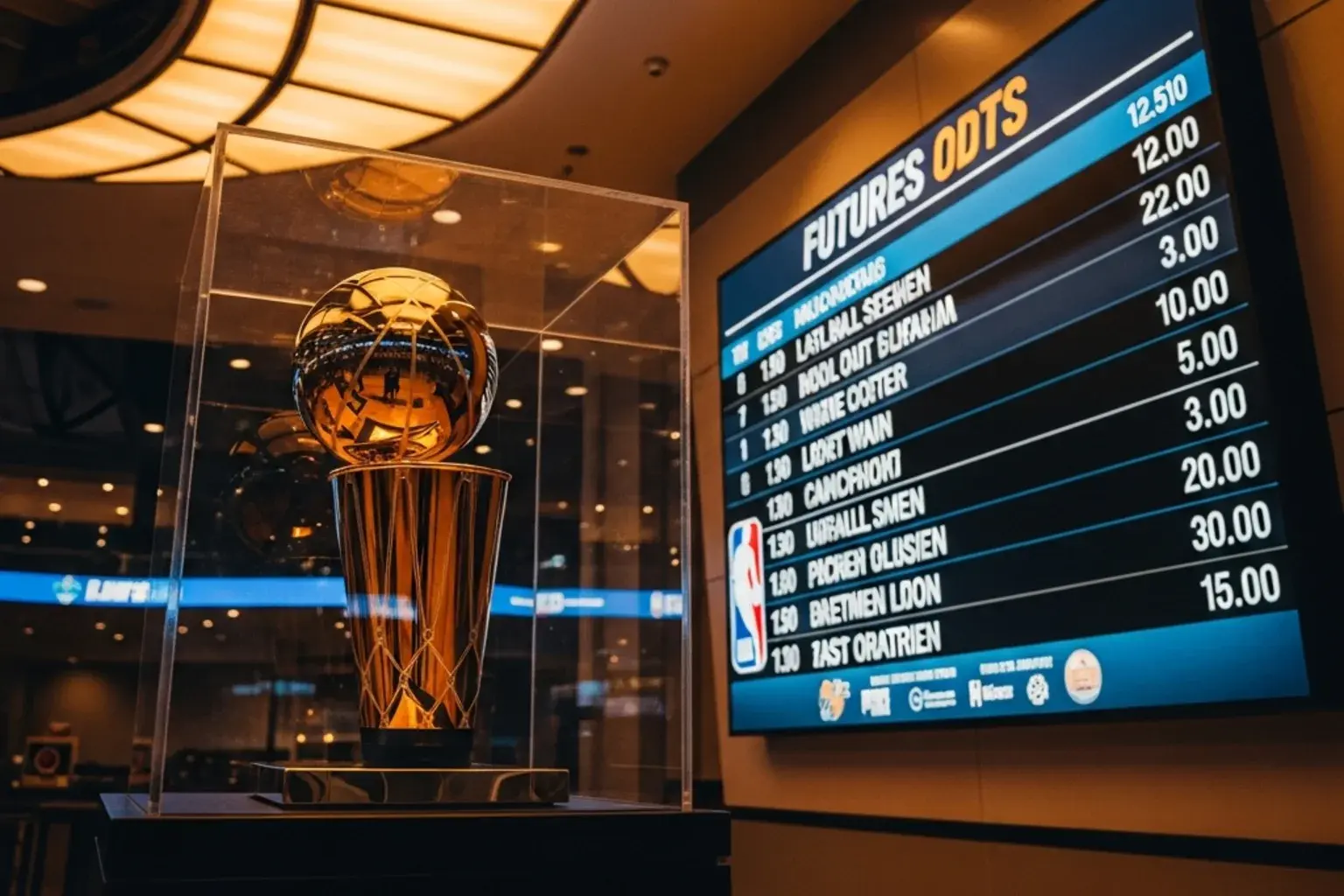
Championship futures pricing follows a predictable cycle. Odds are longest in the off-season, when roster uncertainty is highest. They shorten through free agency and the draft as rosters solidify. They move again during the pre-season based on early returns, and they compress dramatically once the regular season confirms which teams are genuine contenders.
The best value window for championship futures sits between the end of free agency and the start of the regular season. By that point, you know the rosters, you know the coaching staffs, and you can make informed projections. But the market has not yet been shaped by actual game results, so off-season narratives still dominate pricing. Teams that made quiet but effective moves are often underpriced, while teams that generated headlines with flashy signings carry inflated prices driven by public money.
I place my championship futures in two tranches. The first tranche goes down in late September — my pre-season conviction plays at the longest available odds. The second tranche waits until the first six weeks of the regular season, when I can identify teams that are performing better or worse than the market expected. A team priced at 15.00 before the season that opens 12-4 might have moved to 8.00 — still valuable if my analysis suggests they are a legitimate top-three contender, but less attractive than the pre-season price. Splitting entries across two windows balances conviction against information.
MVP and Award Futures: Narrative Drives Pricing
NBA award futures are the most narrative-driven market in all of sports betting. MVP voting is decided by media members who are influenced by storylines, and those storylines evolve throughout the season. A player putting up historic numbers on a losing team rarely wins MVP. A player with slightly inferior statistics on the league’s best team often does. Understanding how the media narrative shapes voting patterns is more important than raw statistical analysis.
The trap is backing your MVP pick too early. I have held October MVP futures that looked brilliant in December and worthless by March because of injuries, team performance changes, or a rival player emerging with a more compelling narrative. My approach now is to wait until January — roughly 40-45 games into the season — before placing MVP futures. By then, the statistical leaders have established themselves, team records have separated contenders from pretenders, and the narrative arc is visible. The odds are shorter than October, but the information advantage more than compensates.
Other award markets — Rookie of the Year, Defensive Player of the Year, Most Improved Player — follow similar narrative logic but with smaller betting pools and wider margins. I treat these as entertainment bets with capped stakes rather than analytical plays, because the sample sizes for evaluating candidates are too small and too subjective to build reliable models.
Season Win Totals: The Most Analytical Futures Market
If championship outrights are about narrative and timing, season win totals are about maths. A bookmaker posts a line — say, 48.5 wins for the Phoenix Suns — and you bet on whether they finish over or under that number across 82 games. This is the futures market where modelling gives you the biggest advantage, because the question is quantifiable and the inputs are measurable.
I build a projection model every September that estimates each team’s win total based on roster talent, coaching quality, schedule difficulty, and projected health. The model outputs a range — say, 46-52 wins for Phoenix — and I compare that range to the bookmaker’s line. If the bookmaker posts 48.5 and my model centres at 51, the over is playable. If my model centres at 48, the line is sharp and I pass.
The average NBA salary of $10.54 million means roster turnover is constant — teams reshape significantly every off-season, and pre-season projections must account for new player integration, chemistry development, and coaching system changes. A team that added three rotation players in free agency needs twenty games to establish its identity, and early-season performance may not reflect the team’s true talent level. My model weights the first twenty games at 50% of their face value for exactly this reason.
Hedging and Cashing Out NBA Futures
One advantage UK bettors have with futures is the ability to hedge or cash out as the season progresses. If you backed a team at 15.00 to win the championship and they reach the Conference Finals, the live futures price might sit at 3.50. You can either let the bet ride, place a hedge bet on the opposing team, or use your bookmaker’s cash-out feature to lock in a guaranteed profit.
Hedging is straightforward maths. If your original bet was twenty pounds at 15.00, the potential payout is 300 pounds. If the team reaches the Finals as the favourite at 1.60, you could bet 120 pounds on the opponent at the appropriate moneyline odds to guarantee a profit regardless of the result. The guaranteed profit will be less than the full 300-pound payout, but it eliminates the risk of walking away with nothing after months of waiting.
I hedge selectively. If my original analysis still supports the team winning the championship, I let the bet ride and accept the variance. If injuries, form, or matchup concerns have weakened my conviction, I hedge partially — locking in some profit while leaving upside if the original pick comes through. The worst decision is to hedge reflexively out of anxiety rather than analysis. Futures require patience, and hedging too early or too aggressively converts potential big wins into guaranteed small ones. Understanding how implied probability works helps you evaluate whether the hedge price is actually worth taking.