
Calculating the Mathematical Cost of NBA Cash-Out Features
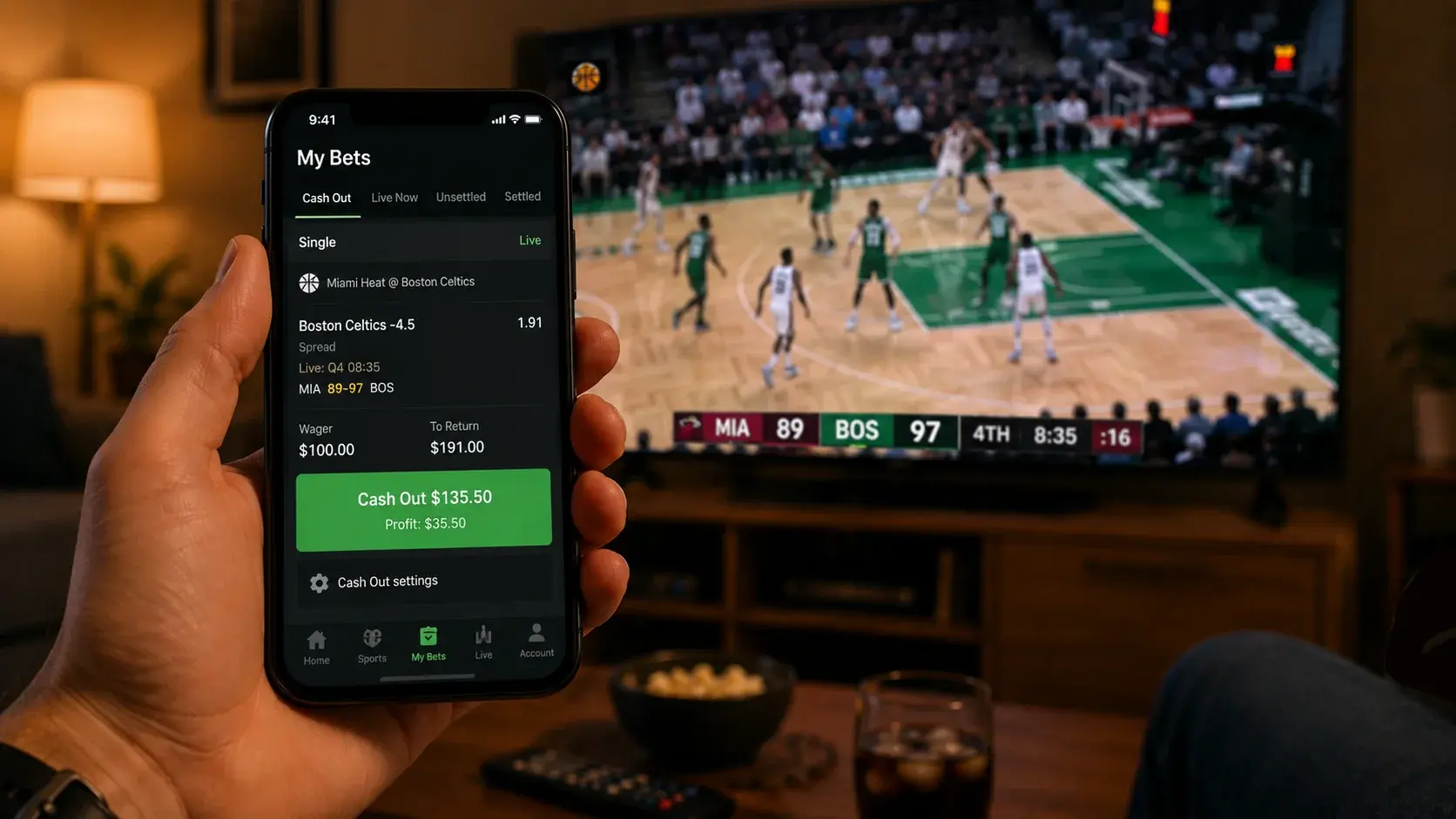
Midway through the third quarter, my bet was sitting pretty — the Celtics led by twelve, and my -5.5 spread was well within range. Then the cash-out offer appeared: eighty-five pounds on a twenty-pound stake. I hesitated, watching the number tick. Within two minutes the lead was cut to seven, and the cash-out dropped to sixty-five. I took it. Boston won by fourteen. My full bet would have returned thirty-eight pounds instead of the sixty-five I pocketed — except the cash-out had already cost me the best possible outcome. That moment crystallised something I should have understood earlier: the cash-out feature is a second market, and the bookmaker has an edge on it just like every other market they offer.
With 78.5% of UK sports betting revenue generated online, cash-out has become one of the most used features in mobile betting apps. Every major UK-licensed bookmaker offers it on NBA markets, and the interface is designed to trigger action — the fluctuating green number, the visual urgency, the implicit suggestion that you should grab your profit before it disappears. Understanding the mathematics behind cash-out is essential to using it wisely rather than reactively.
How Bookmakers Calculate Cash-Out Offers
A cash-out offer is not a gift. It is a new bet priced by the bookmaker in real time. The calculation works like this: the bookmaker assesses the current probability of your bet winning based on the live state of the game, applies their margin, and offers you a settlement that is less than the mathematically fair value of your position.
Suppose you have a twenty-pound bet at 1.91 on the Celtics -5.5, with a potential return of 38.20. At halftime, the Celtics lead by ten. The bookmaker estimates your bet now has a 75% chance of winning. The fair value of your position is 0.75 x 38.20 = 28.65. But the cash-out offer will be lower — perhaps 25 to 27 pounds — because the bookmaker takes a margin on the settlement. That margin typically runs between 5% and 15%, depending on the operator and the market.
The result is that every cash-out you accept is a slightly negative-expected-value transaction. You are selling your position back to the bookmaker at a discount. Over hundreds of cash-outs, this systematic underpricing accumulates into a meaningful drag on your returns. The 29 million active UK online gamblers represent an enormous pool of cash-out activity, and the margins on those settlements contribute meaningfully to bookmaker revenue.
When Cash-Out Makes Strategic Sense
Despite the mathematical disadvantage, there are situations where cashing out is the right decision. The key is distinguishing between emotional cash-outs and strategic ones.
Strategic cash-out scenario one: your original analysis has been invalidated. You backed a team based on a specific game plan — pressing defence, high pace, attacking the paint. At halftime, you can see the opponent has neutralised that game plan, the pace is slower than expected, and your team is winning on unsustainable shooting. The lead looks fragile. In this case, cashing out reflects updated analysis, not panic. You are not selling because you are scared; you are selling because your thesis is broken and the current lead is masking a deteriorating situation.
Strategic cash-out scenario two: injury to a key player. If your bet depends on a specific player’s performance and that player leaves the game with an injury, the probability of your bet winning may have dropped more than the cash-out offer reflects. Bookmakers sometimes lag in adjusting cash-out calculations after in-game injuries, creating a brief window where the offer is more generous than the updated probability warrants.
Strategic cash-out scenario three: bankroll protection in high-stakes spots. If a single bet represents an unusually large percentage of your bankroll — because you combined it in an accumulator that has run hot — cashing out to lock in a return can be prudent risk management regardless of the mathematical disadvantage. The certainty of a guaranteed return is worth the margin cost when the alternative is losing everything on the final leg.
The Emotional Trap and How to Avoid It
Most cash-outs are emotional, not strategic. They happen because the green number on screen triggers loss aversion — the psychological principle that losing hurts roughly twice as much as winning feels good. When your bet is in profit, the fear of that profit disappearing overwhelms the rational calculation of expected value.
I combat this with a pre-game rule: before placing any NBA bet, I decide in advance whether I will consider cashing out and under what conditions. If the answer is “no cash-out under any circumstances,” that decision is made before the emotional pressure begins. If the answer is “cash out if the star player gets injured,” I have a clear trigger that removes subjective judgment from the equation.
The worst cash-out pattern is the escalating cycle. You cash out a winner early, feel smart for locking in profit, then watch the bet win at full price. Next time, you hold and lose. The inconsistency creates a feedback loop where you are never satisfied — cashing out feels like leaving money on the table, and holding feels like gambling. Break the cycle by picking one approach and sticking with it. Consistency beats optimisation when the margins are this thin.
Partial Cash-Out and NBA Accumulator Hedging
Some UK bookmakers offer partial cash-out, where you settle a portion of your bet while leaving the rest active. This is the most strategically versatile form of early settlement because it lets you lock in some profit without fully exiting your position.
On NBA accumulators, partial cash-out becomes particularly useful. Suppose you have a four-leg NBA accumulator with three legs won and one remaining. The cash-out offer is 120 pounds on a ten-pound stake. Partial cash-out lets you settle fifty percent — sixty pounds guaranteed — while leaving five pounds running on the final leg at full payout odds. If the final leg wins, you collect the remaining proportional payout plus the sixty pounds already secured. If it loses, you walk away with sixty instead of nothing.
The maths on partial cash-out is the same as full cash-out — the bookmaker takes a margin on the settled portion. But the flexibility it provides for managing accumulator risk makes it a tool I use regularly. I default to cashing out 40-50% of an accumulator when three of four legs have landed and the fourth is uncertain. This approach smooths the variance of accumulator betting without eliminating the upside entirely.