
Analyzing the Gap Between Opening and Closing NBA Lines
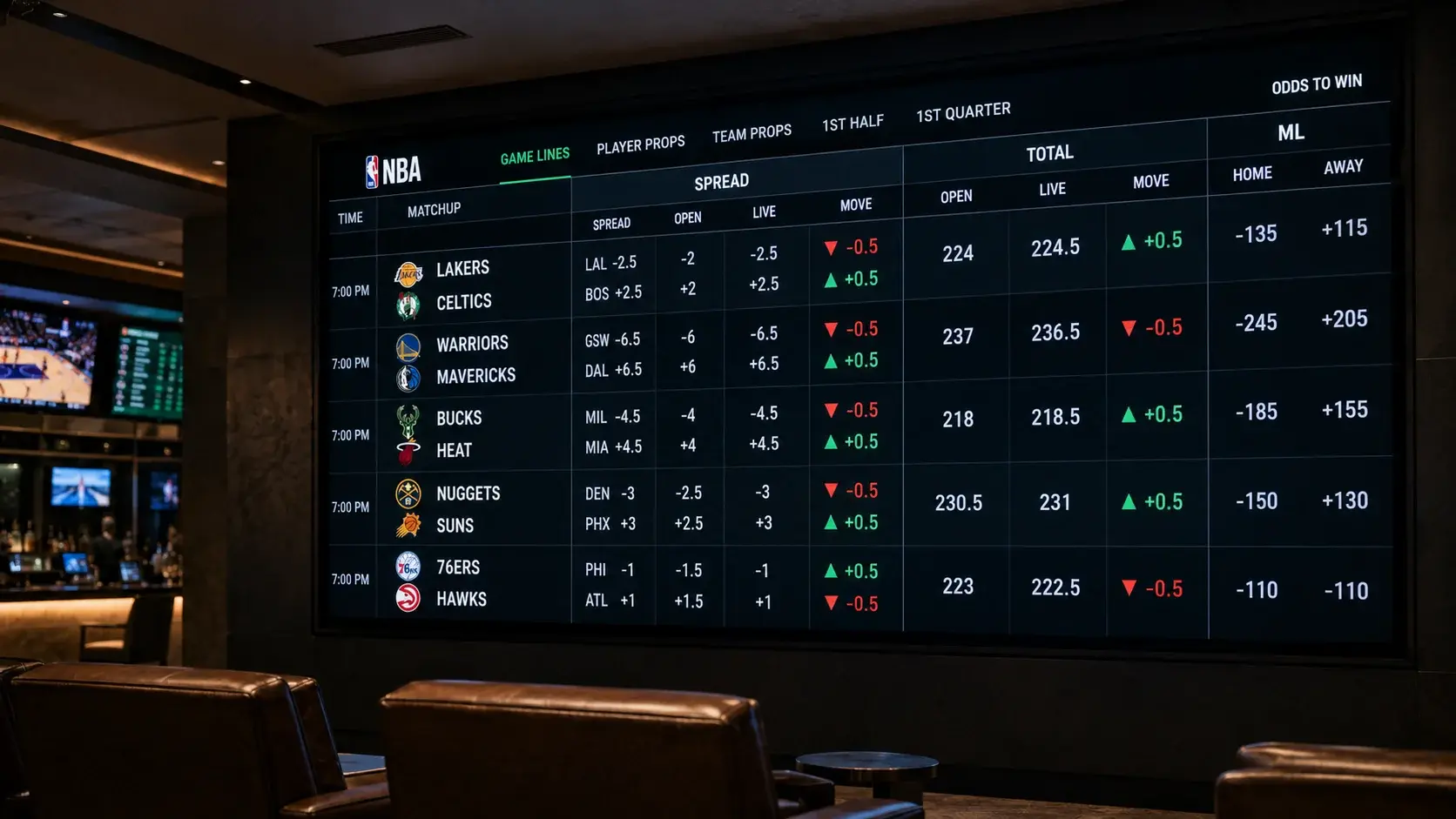
I remember staring at a Celtics-Nets spread that opened at Boston -3.5 on a Monday morning and closed at -5 by tip-off that evening. No injury news, no roster changes, no weather events — just a steady march from 3.5 to 5 driven entirely by betting action. Understanding why that number moved and what it means is one of the most valuable skills in NBA betting, and one that most UK punters overlook entirely.
The global sports betting market reached $100.9 billion in 2024, and every pound of that volume exerts pressure on lines. Bookmakers do not set odds based purely on their own analysis — they set an opening line, observe where the money flows, and adjust to balance their liability. When sharp bettors — professionals who consistently win — load one side heavily, the line moves. Tracking that movement tells you which side the smartest money in the market favours.
Opening Lines, Closing Lines, and Closing Line Value
The opening line is the bookmaker’s first estimate of the correct number. It is informed by models, historical data, and market consensus, but it is imperfect because no model accounts for everything. From the moment the opening line is posted, money begins flowing, and the line adjusts.
The closing line — the final odds at tip-off — is the most efficient price the market produces. It incorporates all available information, including sharp money, injury updates, and public betting patterns. Beating the closing line — consistently placing bets at better odds than the closing price — is the single most reliable indicator of long-term betting skill. If you regularly back teams at -3.5 when the closing line moves to -5, you are getting a better price than the final market consensus, and that edge compounds over hundreds of bets.
I check closing line value for every bet I place. Over a season, if my bets consistently close at worse prices than I got, my process is working. If I consistently take prices that the market later moves through, I am on the wrong side of the information flow. This metric is more predictive of long-term profitability than win rate alone.
When to Bet Early and When to Wait for the Close
This is the practical question every NBA bettor faces: do I grab the opening line or wait for the closing price? The answer depends on which side you are taking and what you expect the market to do.
If your analysis aligns with what you expect sharp money to favour — and the opening line is still at the original number — bet early. You are getting the best price before the market corrects in your direction. Every half-point the line moves against you after your bet is additional value you captured by acting early.
If you are betting against the expected sharp movement — backing a public favourite that you think is underpriced — waiting often makes sense. Public money inflates favourites’ lines throughout the day, and by tip-off the number may have moved to a point where the handicap offers better value for your contrarian view.
I maintain a simple rule: bet early on underdogs and late on favourites. Underdogs tend to attract sharp money that shortens their odds as the day progresses, so grabbing the longer opening price is advantageous. Favourites tend to attract public money that inflates their line, so waiting lets the number move in your favour. This rule does not apply universally, but it provides a useful default when I do not have specific information about expected sharp action on a game.
Line Movement Red Flags and False Signals
Not every line move is meaningful. Some shifts are noise, driven by a single large recreational bet, a bookmaker adjusting its own liability exposure, or an error in the opening line that the market corrects quickly. Distinguishing signal from noise requires context.
A genuine sharp move typically happens within the first hour of the opening line’s release and involves a shift of at least half a point on the spread. It is sustained — the line does not bounce back to the original number. And it is confirmed across multiple bookmakers simultaneously. If one UK operator moves a line from -4 to -4.5 while three others hold at -4, the move is likely operator-specific liability management rather than a sharp signal.
Injury-driven line moves are the most straightforward to interpret. When a starting player is ruled out and the line shifts two points, that is a direct recalculation of the game’s expected outcome. These moves carry no predictive value about sharp betting — they reflect new information that everyone has access to simultaneously. I never read predictive intent into injury-driven line movement. The market is simply repricing reality, not signalling which side to take.
The most dangerous false signal is the “steam move” — a rapid line shift across the entire market that occurs when syndicates coordinate simultaneous bets at multiple bookmakers. Steam moves are genuine sharp action, but they happen so fast that by the time you notice them, the value has evaporated. Chasing steam moves after the fact is a losing strategy. The edge belonged to the bettors who triggered the move, not to the followers who pile on after the line has already shifted.