

Translating US vs UK NBA Betting Terminology
My first attempt at following American NBA betting content ended in confusion within two minutes. The podcast host mentioned “the juice on the Celtics minus-seven,” “a steam move on the total,” and “Giannis as a plus-money dog.” I understood each English word individually. Together, they meant nothing to me. The UK betting vocabulary and the American sports betting lexicon share a sport but speak different languages, and bridging that gap is the first step to consuming the sharpest NBA analysis available.
The global sports betting market reached $100.9 billion in 2024, and the UK contributed $11.2 billion in sports betting revenue. Despite being one of the world’s largest betting markets, the UK uses terminology that often differs from the American vocabulary that dominates NBA content. This glossary translates every term you will encounter, organised alphabetically and cross-referenced with UK equivalents wherever they exist.
A through F
ATS stands for Against the Spread. When someone says a team is “12-5 ATS,” they mean the team has covered the point spread in 12 of 17 games. This is the single most referenced statistic in American NBA betting discourse, and it measures something different from win-loss record. A team can be 10-7 in wins and losses but 12-5 ATS if they outperformed expectations even in some of their losses. Tracking ATS records is foundational to spread betting analysis.
Bankroll is the total amount of money you have set aside for betting. It is not your savings account or your monthly income — it is a dedicated fund that you can afford to lose entirely without affecting your daily life. Professional bettors typically risk 1-3% of their bankroll on any single bet. If your bankroll is one thousand pounds, your standard stake is ten to thirty pounds.
Chalk refers to the favourite. “Betting the chalk” means backing the favourite. In NBA betting, chalk bets are popular because the better team wins outright more than 60% of the time, but covering the spread is a different question entirely. Favourites cover at roughly 50%, which means the chalk is not inherently profitable on the spread.
Cover means the team beat the spread. If the Celtics are -6.5 and win by eight, they covered. If they win by five, they did not cover. This verb is used constantly in American analysis and is the equivalent of the UK phrase “beating the handicap.”
Dog is short for underdog. “Taking the dog” means betting on the team getting points on the spread. In UK terminology, this is equivalent to backing the plus-handicap side. Underdogs in the NBA cover the spread slightly more often than favourites over large samples, though the margin is thin and varies by season.
Edge is the mathematical advantage a bettor holds over the bookmaker on a specific bet. If you believe a team has a 57% chance of covering and the odds imply 52.4%, your edge is approximately 4.6 percentage points. Without a genuine edge, every bet is a slow donation to the bookmaker’s margin. Approximately 10% of the UK population bets on sports online, and the vast majority do so without ever calculating whether they hold an edge.
Favourite is the team expected to win. In decimal odds, the favourite has odds below 2.00 on the moneyline. On the spread, the favourite is the team giving points (indicated by a minus sign). The favourite and the chalk are the same thing — different words from different sides of the Atlantic for the same concept.
G through M
GamStop is the UK’s national self-exclusion scheme for online gambling. Registering with GamStop blocks you from all UKGC-licensed gambling sites for a minimum of six months. It is a critical responsible gambling tool and entirely free to use. The term has no American equivalent because US self-exclusion operates state by state rather than nationally.
Handle is the total amount of money wagered on a particular game or market. A high-handle game attracts significant betting volume, which typically means tighter lines and less opportunity for mispricing. Low-handle games — early-season matchups between small-market teams — often carry wider margins but also more potential for value.
In-play is the UK term for live betting — placing bets while a game is in progress. The American equivalent is “live betting” or “in-game betting.” In-play NBA markets update every few seconds as the score changes, and the odds reflect the current game state including score, time remaining, and possession. The NBA drew 170 million viewers in the 2025-26 season across US platforms, and the in-play market grows every year as more bettors engage during broadcasts.
Juice is the American term for the bookmaker’s commission on a bet. In the UK, this is called the “overround” or sometimes “the vig” (short for vigorish). On a standard -110/-110 American spread market, the juice is the 10% premium you pay for the privilege of betting. In decimal terms, 1.91/1.91 on both sides of a spread represents the same juice — you need to win 52.4% of the time just to break even.
Kelly Criterion is a mathematical formula for calculating optimal bet size based on your perceived edge and the odds offered. The full Kelly formula often produces stakes that are too aggressive for most bettors, so a quarter-Kelly or half-Kelly approach is more common. The formula is: (bp – q) / b, where b is the decimal odds minus 1, p is the probability of winning, and q is the probability of losing. The bankroll management guide covers Kelly in practical detail.
Line refers to the point spread or the odds on any given market. “What’s the line on the Lakers game?” means “what is the spread?” In UK parlance, this is equivalent to asking for the handicap. The line moves throughout the day as bets come in and new information emerges.
Moneyline is the simplest bet type — picking the outright winner with no spread involved. In the UK, this is sometimes called “match winner” or “to win.” Moneyline odds in American format use plus and minus signs; in UK decimal format, the favourite is below 2.00 and the underdog is above 2.00.
N through S
NBA Cup refers to the In-Season Tournament, a mid-season competition introduced in the 2023-24 season. Games count toward the regular-season record but also feed into a separate single-elimination bracket. The NBA Cup creates unique betting markets because motivation levels vary — some teams treat it seriously as a potential trophy, while others prioritise rest and regular-season positioning.
Over/Under is a bet on the combined total points scored by both teams. The bookmaker sets a line — say, 224.5 — and you bet whether the actual total will be over or under that number. In UK terminology, this is a “totals” bet. The half-point ensures no push. NBA totals are influenced heavily by pace, three-point shooting volume, and referee tendencies.
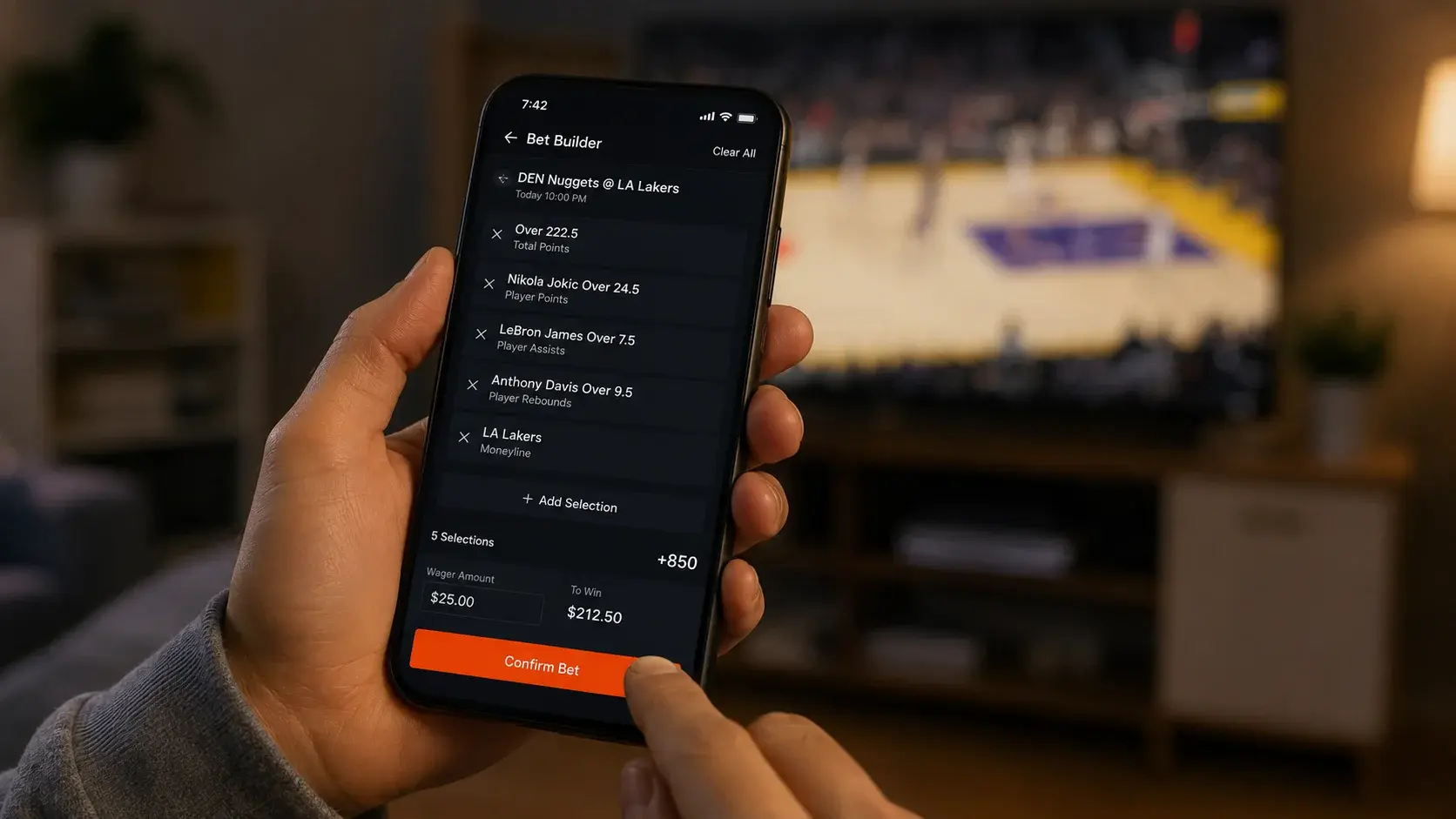
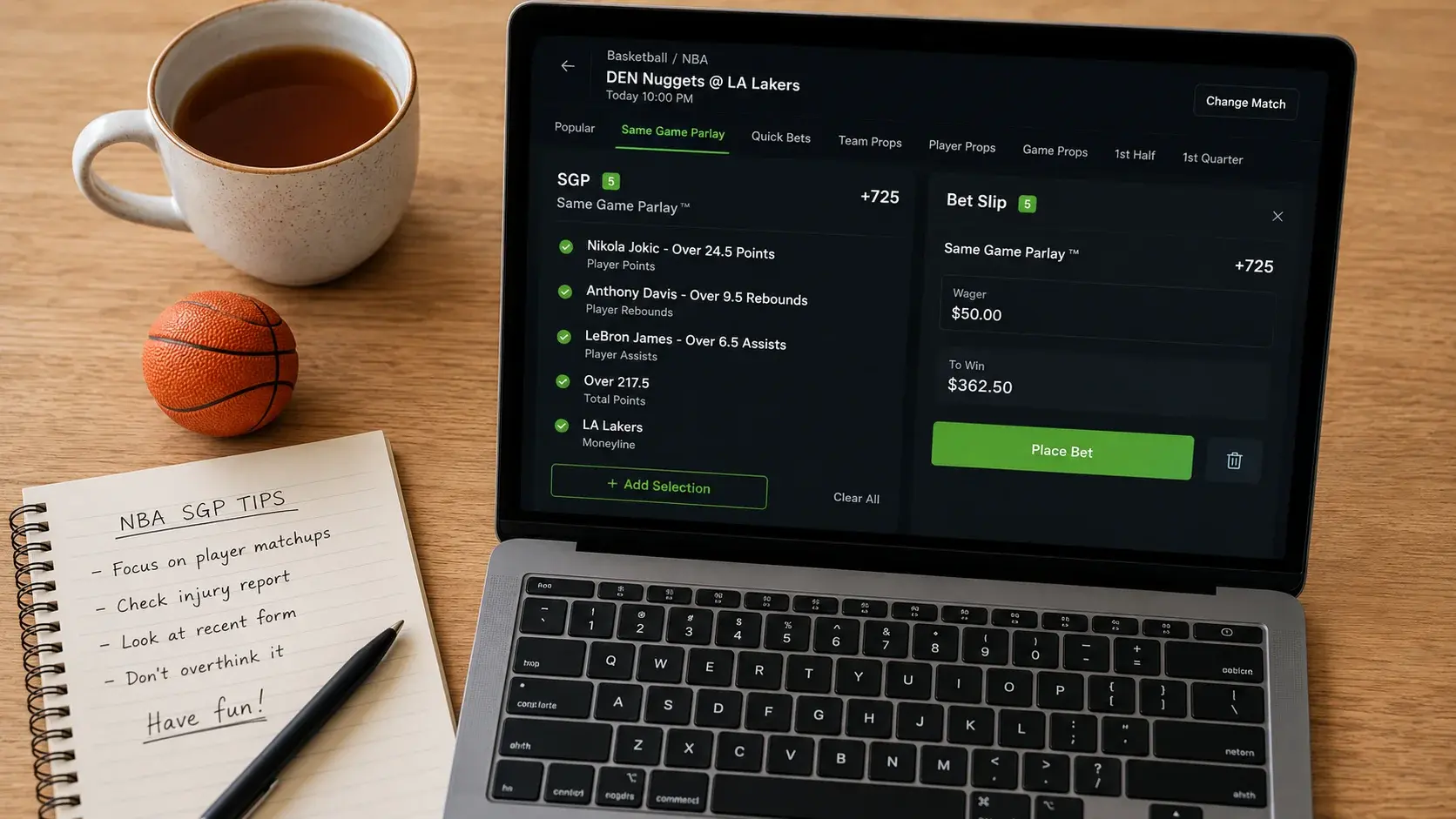
Parlay is the American term for an accumulator. Multiple selections combined into a single bet where all legs must win. The odds multiply together, and the potential payout increases with each additional leg — but so does the probability of losing. UK bettors are more familiar with the term “accumulator” or “acca,” but the mechanic is identical.
Prop bet is short for proposition bet — a wager on a specific event within a game rather than the game outcome itself. Player props include points, rebounds, assists, and three-pointers made by an individual player. Game props include first team to score, highest-scoring quarter, and margin of victory. In October 2025, 34 individuals were arrested in connection with federal investigations into illegal betting and schemes linked to NBA players, and the integrity concerns around prop bets have led to calls for restrictions from both the NBA and NCAA.
Push occurs when the result lands exactly on the spread number, resulting in no winner. Your stake is returned. On half-point spreads, pushes are impossible, which is why most NBA lines include the .5. On whole-number spreads and Asian handicaps, pushes are a regular occurrence.
ROI stands for Return on Investment — total profit divided by total amount wagered, expressed as a percentage. A 3% ROI over 500 bets is excellent. A -5% ROI over the same sample means you are losing at roughly the rate of the bookmaker’s built-in margin. ROI is the correct measure of betting performance, not win rate alone.
Sharp refers to a professional or highly skilled bettor whose action moves lines. When “sharp money” comes in on one side of a spread, bookmakers adjust the line in response. The opposite of sharp is “square” or “public” — recreational bettors whose collective action is typically faded by sharps. The distinction matters because line movements driven by sharp money carry different information than movements driven by public volume.
Spread is the American term for what UK bookmakers call a handicap. One team is given a virtual points advantage or disadvantage. The spread equalises uneven matchups by requiring the favourite to win by more than the line. A spread of -7.5 means the favourite must win by eight or more for a spread bet to pay out.
T through Z
Teaser is a special type of parlay where the bettor adjusts the spreads on multiple games in exchange for reduced odds. A six-point NBA teaser would move a -7.5 spread to -1.5. Teasers are far less common in NBA betting than in American football because NBA scoring margins are more variable and the mathematical edge from “buying” points is smaller.
Total is another word for the over/under line. “The total is 226” means the bookmaker has set the combined points line at 226. A “total move” means the line has shifted due to betting action or new information. NBA totals are among the most actively traded markets in sports betting because they are driven by quantifiable variables like pace and efficiency.
UKGC stands for the United Kingdom Gambling Commission — the regulatory body that licenses and oversees all gambling operators serving UK customers. Every bookmaker you use for NBA betting should hold a valid UKGC remote gambling licence. Operating without one is illegal, and using an unlicensed operator means you have no regulatory protection if a dispute arises. The 48% of UK adults who gamble do so under the UKGC’s regulatory umbrella.
Value is the core concept in profitable betting. A bet has value when the true probability of the outcome exceeds the implied probability from the odds. If you believe a team covers the spread 56% of the time and the odds imply 52.4%, the bet has value. Finding value consistently is the only path to long-term profitability, and every other concept in this glossary ultimately serves the identification of value.
Vig, short for vigorish, is the bookmaker’s commission. It is synonymous with “juice” in American terminology and “overround” in UK terminology. The vig is the reason you need to win more than 50% of even-odds bets to profit. On standard NBA spreads at 1.91 decimal, the vig is approximately 4.5%. Every bet you place includes this invisible tax, and ignoring it is the most fundamental error in sports betting.