
Avoiding Rapid Drawdowns in an 82-Game Season
During the 2019-20 NBA season I was riding a hot streak and decided my edge was large enough to increase my stakes. I doubled my unit size after five consecutive winning nights. Two weeks later, a seven-game losing run wiped out my entire bankroll. Not because my analysis was wrong — I was hitting at 54% on spread bets, which is genuinely profitable long-term. I failed because my staking was reckless, and no win rate survives reckless staking.
The UK gambling industry generates 60% of its profits from just 5% of customers who are problem gamblers or at-risk individuals. That statistic should disturb anyone who bets seriously, because it illustrates how the system is structured to extract maximum value from those with the weakest discipline. Bankroll management is the single most important skill in NBA betting — not because it helps you pick winners, but because it keeps you in the game long enough for your winners to matter.
Setting Your NBA Bankroll: How Much Is Enough
Your NBA bankroll is the total amount you allocate to basketball betting for a full season. It is not your savings, not your rent money, not the contents of your current account. It is a dedicated fund you can afford to lose entirely without financial or emotional consequence.
I recommend a bankroll that covers at least 100 units, where one unit is your standard bet size. If you are comfortable risking ten pounds per bet, your bankroll should be at least one thousand pounds. This gives you enough runway to absorb the inevitable losing streaks without adjusting your strategy or your stakes. A fifty-unit bankroll is the absolute minimum for NBA betting — anything less, and a normal run of variance can bust you before you have time to demonstrate an edge.
The reason for 100 units relates directly to the mathematics of NBA betting. Even a skilled bettor hitting at 55% on spread bets will experience losing streaks of eight, ten, or twelve bets during a season. With a 100-unit bankroll and flat one-unit stakes, a twelve-bet losing streak costs 12% of your total. Painful but survivable. With a twenty-unit bankroll, the same streak costs 60%. That is catastrophic.
Flat Staking vs Percentage Staking: Which Works for NBA
Flat staking means betting the same fixed amount on every selection — one unit, every time, regardless of confidence level. Percentage staking means betting a fixed percentage of your current bankroll, so the stake shrinks as your bankroll drops and grows as it increases.
I use flat staking for NBA betting and have for years. The reason is psychological as much as mathematical. With percentage staking, your stakes fluctuate based on recent results, which creates a feedback loop. After a losing streak, your stakes drop — meaning you need more winners just to recover what you lost at higher stakes. After a winning streak, your stakes increase — meaning a subsequent loss costs more. The system is mathematically sound but emotionally destabilising for most bettors.
Flat staking eliminates the emotional component. One unit, every bet, no exceptions. If my bankroll was one thousand pounds and my unit is ten pounds, I bet ten pounds whether I am on a seven-game winning streak or a five-game losing streak. The discipline this imposes is worth more than any marginal mathematical advantage percentage staking might provide. The global sports betting market hit $100.9 billion in 2024, and a meaningful share of that flows through the accounts of bettors who adjust their stakes based on emotion rather than process. Do not be one of them.
The Confidence Trap and Why Three-Tier Staking Fails
A common piece of advice is to use a three-tier staking system — one unit for standard bets, two units for strong conviction, three units for “locks.” I tried this for two full seasons. The results were worse than flat staking, and the reason is revealing.
The problem is that bettors systematically overestimate their confidence. The games I rated as three-unit “locks” did not win at a higher rate than my one-unit plays. My confidence correlated with the quality of the narrative I had constructed, not with the actual probability of the outcome. A compelling story about why the Lakers would cover made me feel certain, but feeling certain and being right are different things entirely.
Variable staking only works if your confidence calibration is accurate — if your three-unit plays genuinely win at a meaningfully higher rate than your one-unit plays. Track this honestly for a full season before implementing tiered staking. If your “locks” win at the same rate as everything else, you are not calibrated, and variable staking is just a sophisticated way to increase your average stake size without admitting it.
Tracking, Review, and the Discipline of Honest Records
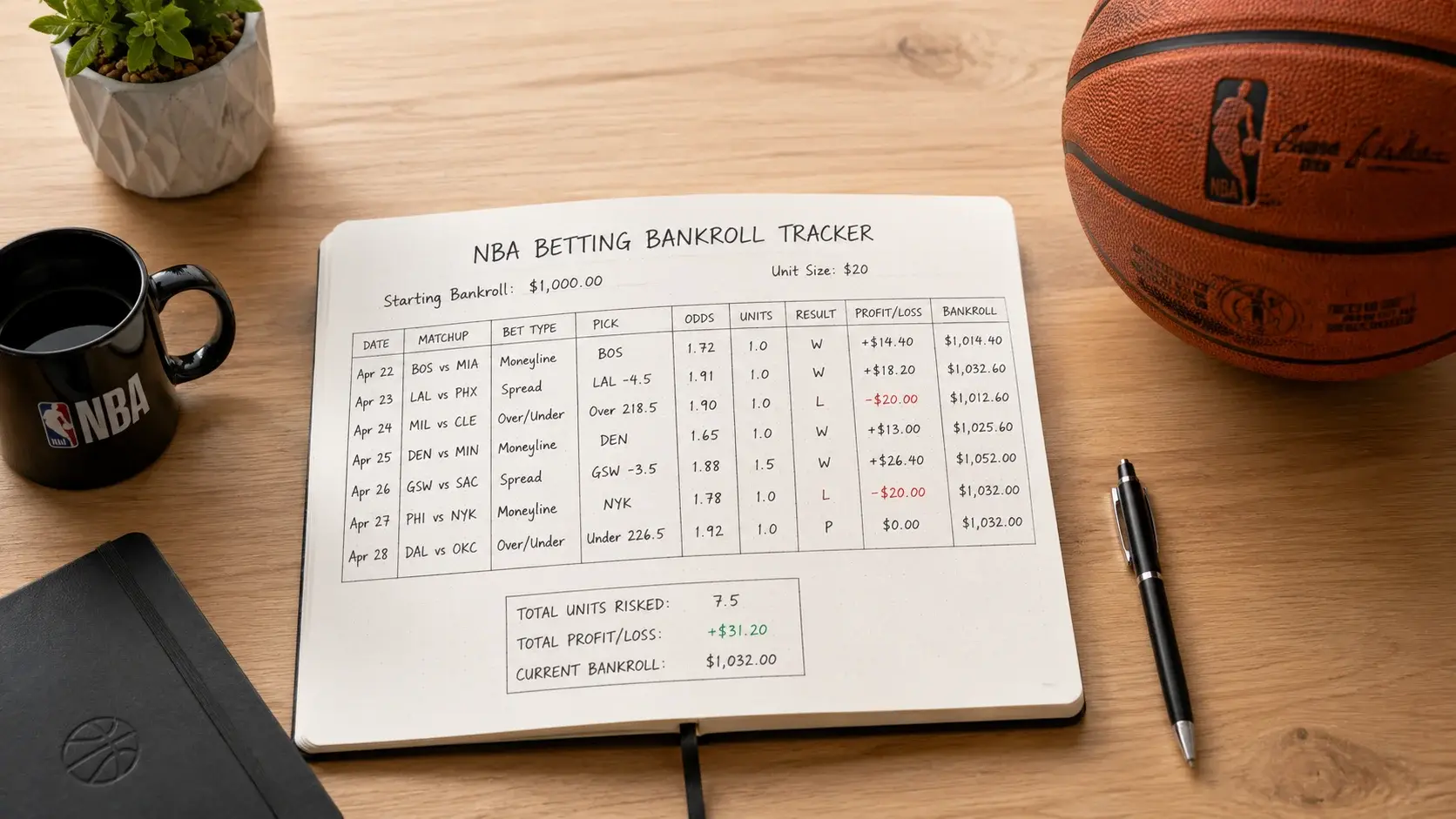
Every bet goes in a spreadsheet. The date, the game, the market, the selection, the odds, the stake, and the result. No exceptions, no skipping losing bets, no rounding the numbers to make them look better. The bookmaker’s win rate hit a record 9.7% in the US in 2025, and one reason for that figure is that most bettors do not track their results accurately enough to recognise when they are losing.
I review my tracking spreadsheet every two weeks during the NBA season. The review asks three questions. First, what is my overall ROI? If it is negative after 200-plus bets, my process has a problem that analysis alone is not solving. Second, which market types are profitable and which are not? My spread bets might be positive while my props are bleeding — that information tells me where to allocate more volume and where to cut back. Third, am I following my staking rules? If I find three-unit bets in the spreadsheet on nights I was supposed to be flat staking, discipline has slipped, and discipline slippage precedes bankroll damage.
The hardest part of record-keeping is honesty. It is tempting to exclude bets you placed impulsively at 2am, or to count a cashed-out bet as a win rather than recording the reduced return. Resist both temptations. The spreadsheet exists to tell you the truth about your betting, and the truth is the only foundation on which a sustainable NBA betting operation can be built. If your records suggest you should rethink your accumulator strategy, listen to the data rather than your instincts.