
Securing Real Value After the NBA Tip-Off
My most profitable NBA season started the night I stopped placing pre-game bets entirely. Not as a philosophical decision — I simply noticed that my in-play bets were covering the losses from my pre-match selections, and then some. Pre-game markets benefit from hours of sharp money hammering the lines into efficiency. Once the ball goes up, the market reopens with fresh information that bookmakers must price in real time, and that is where gaps appear.
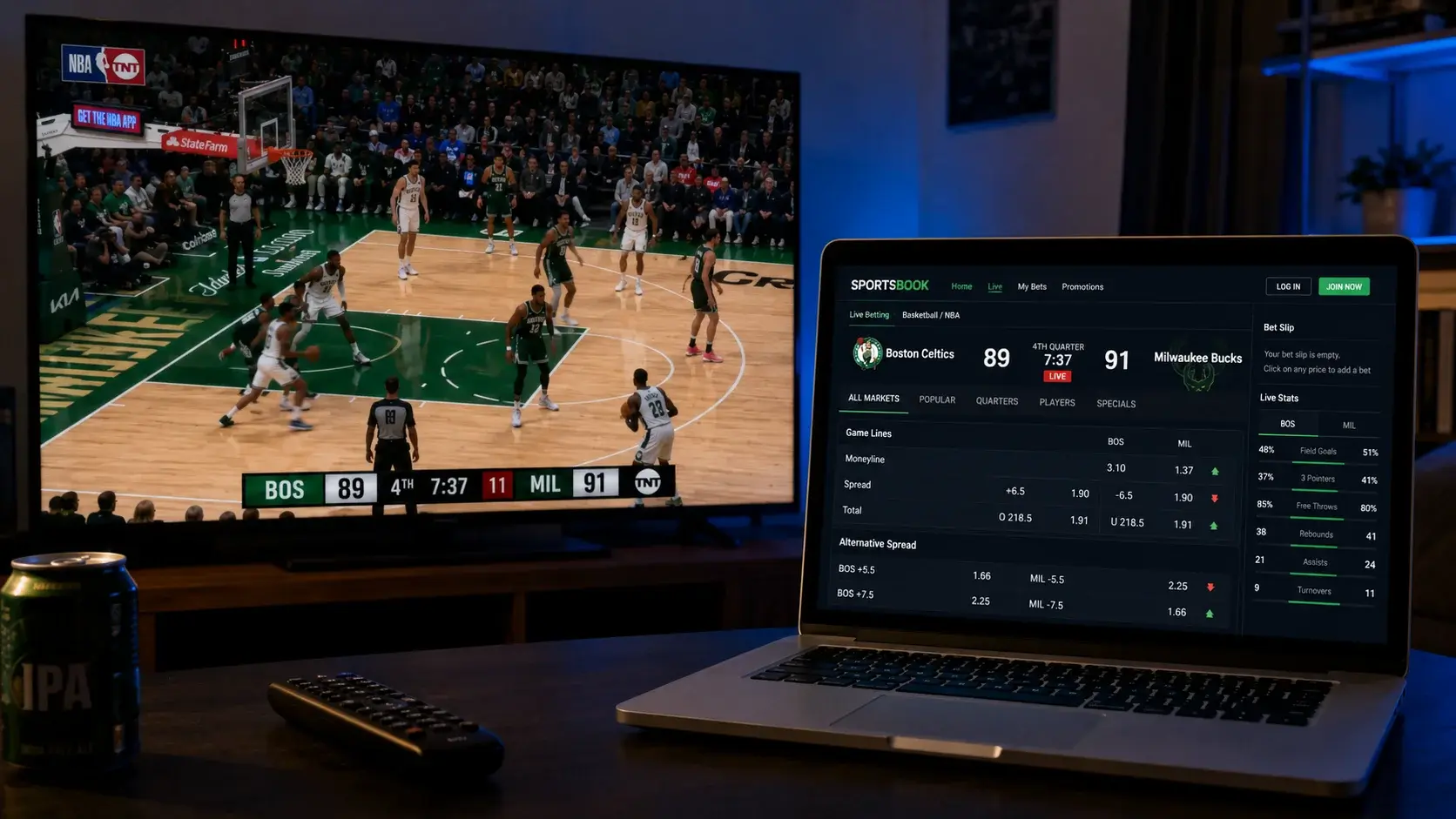
The UK’s online betting segment generates 78.5% of total sports wagering revenue, and a growing share of that action lands on in-play markets. NBA games are uniquely suited to live betting because of their structure — four twelve-minute quarters with natural breaks, frequent scoring, and momentum shifts that create repricing opportunities every few possessions. A team that falls behind by fifteen in the first quarter but has the talent to rally is often mispriced at halftime, because bookmakers must react to what has happened while bettors can anticipate what is likely to happen next.
The First-Quarter Overreaction Window
I call the first eight minutes of an NBA game the overreaction window. Bookmakers adjust live odds based on score differential, and the early minutes produce wild swings that rarely reflect the true probability of the final outcome. A 14-4 run in the opening five minutes might shift the live spread from -3.5 to -12.5 — a massive move based on fewer than twenty possessions.
The data backs this up. NBA teams that trail by ten or more after the first quarter still win roughly 20-25% of the time. That is low, but if the live moneyline prices the trailing team at 5.00 or higher, you are getting odds that imply a 20% chance when the actual probability sits in that range or higher. The mispricing is not enormous, but over a full season of regular live betting, exploiting even a 2-3% edge on these spots compounds into meaningful returns.
The key is selectivity. Not every first-quarter deficit is an overreaction. A team missing its two best players who falls behind early is trailing for legitimate reasons. The overreaction play targets teams at full strength, playing on normal rest, who simply started cold. Shooting variance in small samples is the single biggest driver of early-game score differentials, and shooting variance corrects.
Halftime Spreads and the Coaching Adjustment Factor
Halftime is the most analytical betting window in an NBA game. You have 24 minutes of data, both coaches have made adjustments, and the second-half spread incorporates the first-half performance. What it often fails to fully incorporate is the asymmetry of coaching adjustments.
Elite coaches — the ones who consistently outperform regular-season expectations — make disproportionately effective halftime adjustments. When a top-tier coaching staff trails at halftime, the second-half performance tends to improve more than the market anticipates. I track second-half ATS records by coach and use that data to inform halftime live bets. The sample sizes take a full season to become meaningful, but once you have a reliable database, the patterns are surprisingly stable year to year.
The NBA’s global broadcast consumption hit 1.3 billion hours in the 2025-26 season, a 93% jump year on year. That explosion of content means more data-driven analysis is available to bettors, but most of it focuses on pre-game models. Halftime analysis remains an underserved niche, and bettors willing to do the work during the fifteen-minute break can find lines that reflect the score more than the situation.
Fourth-Quarter Live Totals and Pace Compression
Something changes in the fourth quarter of close NBA games. The pace slows. Possessions lengthen. Coaches tighten rotations to six or seven players. Intentional fouling replaces structured offence in the final two minutes. All of these shifts affect scoring in ways that live totals markets sometimes lag in pricing.
I have found consistent value in fourth-quarter unders when two evenly matched teams enter the final period within five points. The tactical slowdown compresses scoring output relative to what the first three quarters would suggest. The live total for the fourth quarter often reflects an extrapolation from earlier-quarter scoring rates, and that extrapolation breaks down when the game tightens.
Blowouts create the opposite dynamic. When one team leads by twenty-plus entering the fourth, both coaches empty their benches. Bench units play at a different pace and with different efficiency than starters, and the resulting scoring pattern is essentially random relative to the first three quarters. I avoid fourth-quarter totals in blowouts entirely — the variance is too high and the edge too thin to justify the bet. The sweet spot is the competitive game where tactical adjustments create predictable scoring suppression. If you are also tracking totals trends pre-game, those tendencies carry directly into your live fourth-quarter analysis.
Managing Latency and Execution Risk at 2am
Live betting from the UK means operating between 11pm and 3am for most NBA games. That schedule introduces practical challenges that no strategy can overcome if you ignore them.
Stream latency is the biggest issue. If you are watching an NBA game through a bookmaker’s embedded stream, that feed runs five to fifteen seconds behind real time. Sharp bettors with faster data — courtside feeds, real-time play-by-play APIs — can react to events before you even see them. By the time your stream shows a made three-pointer, the live odds have already moved. This does not make live betting unprofitable, but it means you should focus on structural opportunities — halftime lines, quarter breaks, timeout windows — rather than trying to react to individual plays.
Fatigue is the other factor. Making analytical decisions at 2am after a full day of work is not the same as making them fresh. I set hard rules before the evening begins: a maximum number of live bets per night, a maximum total stake, and a firm shutdown time. The NBA season is 82 games per team over six months. There will always be another game, another spot, another opportunity. The discipline to walk away protects your bankroll more effectively than any analytical edge you might find in the final minutes of a late-night Western Conference game.