

Essential 82-Game Tactics Before Placing NBA Bets
My first NBA season as a bettor lasted exactly 11 days. I deposited 200 pounds, had a brilliant opening weekend backing three favourites on the moneyline, then proceeded to lose everything over the next week chasing the same approach on Tuesday and Wednesday night slates that I understood far less than I thought. The deposit was gone before November. The lesson stayed forever. Once you have set up your bankroll, the next crucial step is understanding how NBA point spread betting works to find true handicap value.
The NBA regular season is 82 games per team, spread from mid-October to mid-April. That is an extraordinarily long runway — longer than any other major sport’s season — and it punishes impatience with ruthless efficiency. In the UK, 15% of men and 4% of women place bets on sport, according to the Gambling Commission. Within that population, the overwhelming majority of NBA bettors treat each game as an isolated event. They bet tonight’s game, check the result, and bet tomorrow’s game with no connection between the two. That approach is indistinguishable from random gambling.
An 82-game season is not 82 separate bets. It is one continuous laboratory. The teams you track in November are not the same teams in March — rosters shift, injuries accumulate, coaching adjustments compound. Your job in the first season is not to make money. It is to build a process that, over time, produces better decisions than the market average. That means accepting that the first month will feel slow, the second month will feel frustrating, and the third month is when patterns start to emerge that you could not have seen on day one.
Set a simple target for your first NBA season: track every bet you consider, whether you place it or not, and record why you liked it. At the end of the season, review the ones you placed and the ones you passed on. That comparison — what you bet versus what you skipped — will teach you more about your own biases than any strategy article ever could.
Bankroll Management: The Rule That Keeps You Betting All Season
60% of gambling company profits come from 5% of customers who are problem gamblers or at risk of becoming one. That statistic, from the House of Lords Gambling Industry Committee, should reframe how you think about bankroll management. The bookmaker’s business model depends on people who cannot control their spending. Disciplined bankroll management is not just strategy — it is the single most effective act of self-defence available to you.
The rule is simple and non-negotiable: never bet more than 2% of your total bankroll on a single NBA wager. If you set aside 500 pounds for the season, your maximum stake on any individual bet is 10 pounds. If you lose 50% of your bankroll and are down to 250 pounds, your maximum stake drops to 5 pounds. The percentage stays constant; the unit size adjusts with your balance.
Why 2%? Because the maths of ruin are unforgiving. At 5% per bet, a losing streak of 15 bets — which happens to every bettor at some point during an 82-game season — cuts your bankroll by more than half. At 2% per bet, the same losing streak reduces your bankroll by about 26%. You are still standing, still able to bet, still able to recover when the inevitable regression to the mean kicks in. The average US bookmaker win rate hit a record 9.7% in 2025, which means even skilled bettors face long stretches of losses. Your bankroll must survive those stretches.
I know this advice sounds boring. It is the least exciting thing in this entire guide. It is also the most important. Every successful NBA bettor I have met over 11 years follows some version of this rule. Every failed NBA bettor I have met abandoned it in favour of “I feel good about this one” staking. The correlation is absolute.
Three Bet Types to Start With — and Two to Avoid
Adam Silver acknowledged something important when he said the NBA was not at the table when sports betting was legalised — that these were deals cut between states and gaming operators. That absence created a market where every conceivable bet type proliferated without the league’s input on what was appropriate. As a beginner, you do not need access to 140 markets per game. You need three.
Start with the moneyline. Picking the winner of an NBA game is the simplest bet and the one where your basketball knowledge transfers most directly. You watch the game, you understand which team is better, you back them. The catch is that moneyline odds on heavy favourites are short — 1.15 to 1.30 — which means you need a very high win rate to profit. Use moneylines selectively, primarily on games where you believe a moderate underdog (priced at 2.50 to 4.00) has a genuine chance of winning outright.
Add the point spread once you understand moneyline dynamics. The spread equalises the odds between the two sides, typically pricing both near 1.91. It forces you to think not just about who wins but by how much, which develops a more nuanced analytical muscle. Spend at least two weeks tracking spreads before you start betting them — note where the line opens, where it closes, and whether your pre-game assessment of the margin was closer to reality than the market’s.
The game total (over/under) is your third starter bet. Totals are appealing because they remove the need to pick a side — you are betting on combined scoring, which depends on pace, defensive quality, and game flow rather than on which team prevails. Totals also tend to be slightly less efficient than spreads because the casual public gravitates toward overs (more points feels more exciting), which creates persistent value on unders in specific situations.
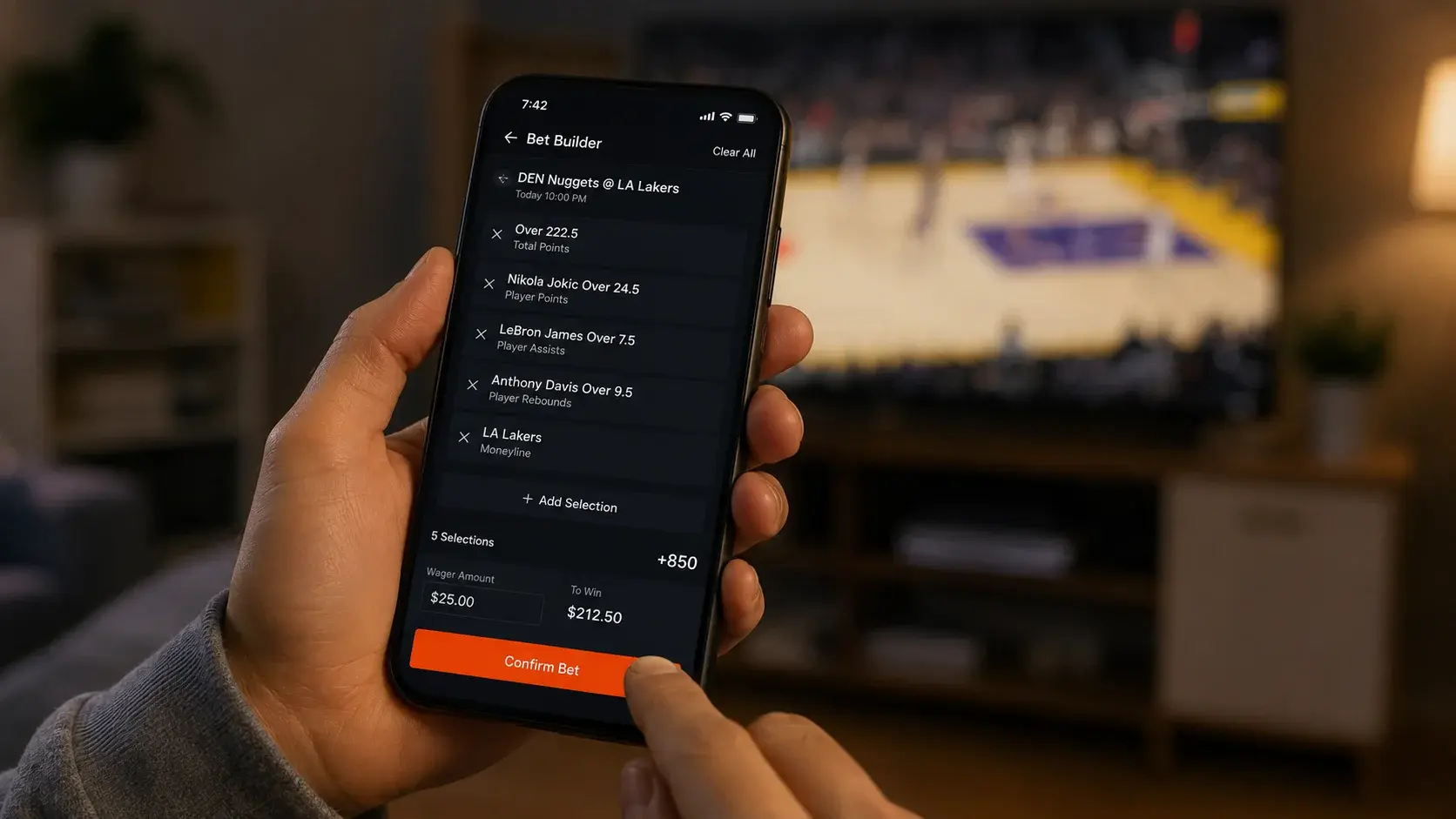
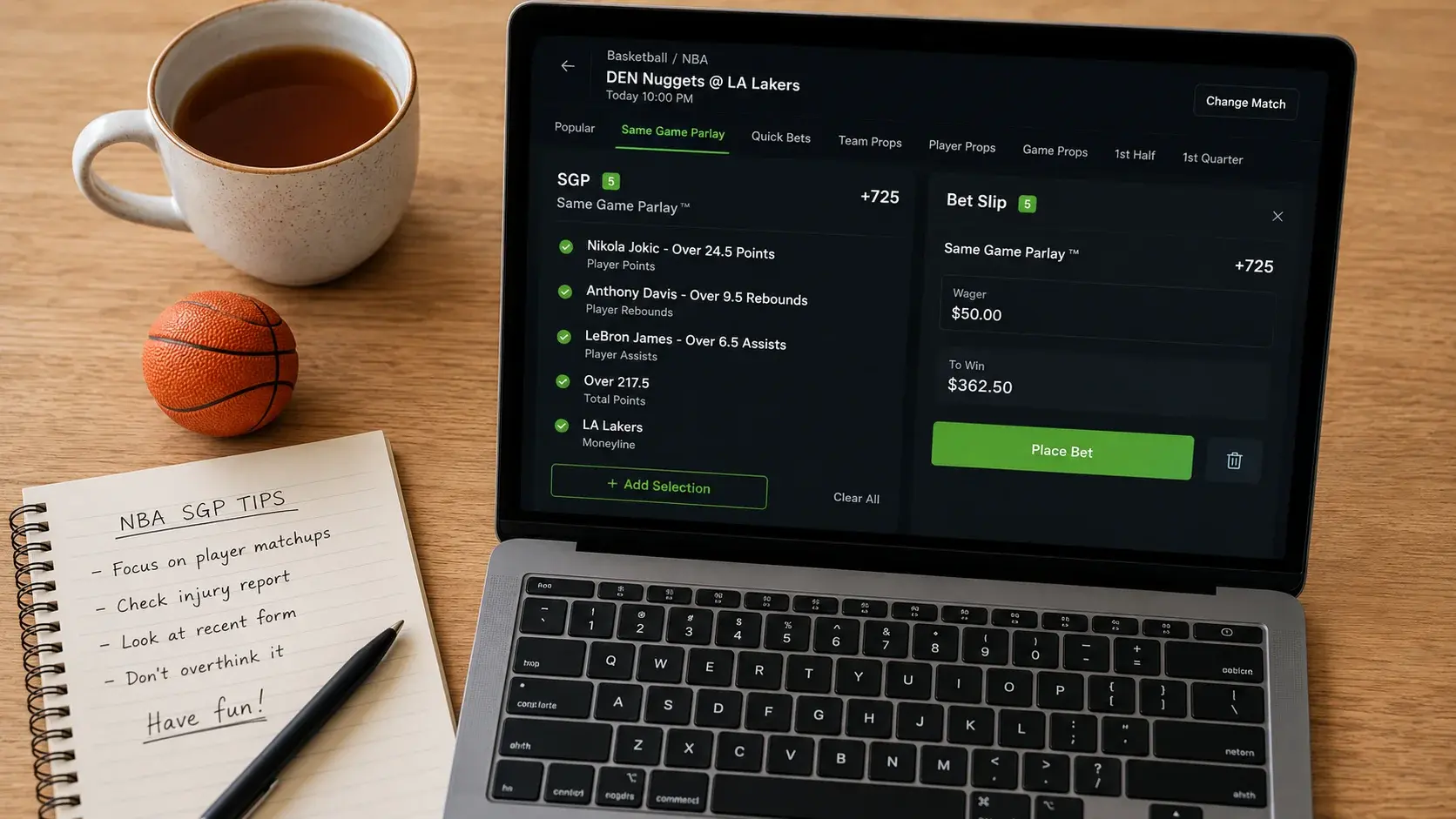
The two to avoid as a beginner: player props and same-game parlays. Props require opponent-specific analysis, minutes projections, and situational awareness that takes months to develop. Parlays combine multiple bets into a single wager with compounding risk — and the bookmaker’s margin on parlays is significantly higher than on single bets. Both markets are designed to be attractive to casual bettors, and both are where the bookmaker makes its fattest profits. Revisit them after your first season, once you have a process you trust.
Using the NBA Schedule as a Betting Calendar
68% of surveyed UK gamblers in February 2026 said they expected to increase their betting volume due to the 2026 sporting calendar, including the FIFA World Cup. The NBA competes for attention in that crowded calendar, and its own internal schedule creates a rhythm that smart bettors can exploit.
The NBA season divides into distinct phases, each with different betting characteristics. October through November is the calibration period: teams are integrating new players, testing lineups, and establishing their identity. Lines during this period are least efficient because the bookmaker is working from last season’s data plus preseason projections, neither of which fully captures the current reality. This is the period where I find the most value — and where beginners should observe most carefully, even if they are not yet betting aggressively.
December through February is the grind. Teams settle into patterns, the market sharpens, and finding edges becomes harder. Back-to-back games, road trips, and the All-Star break create schedule-driven angles that are more reliable than team-quality analysis during this phase. Rest day and back-to-back strategies become particularly valuable here because the market adjusts to team quality faster than it adjusts to schedule fatigue.
March through April is the playoff push. Teams with something to play for — seeding, play-in positioning, home-court advantage — elevate their effort. Teams with nothing to play for rest their stars and coast. The gap between motivated and unmotivated teams is enormous during this stretch, and the market sometimes lags in recognising which teams have mentally checked out. Watch for tanking teams with winning records who stop competing once their seed is locked — their effort level drops, and the spread rarely reflects it fully.
The playoffs, from mid-April through June, are a fundamentally different market. Rotations shorten, intensity increases, and the data from the regular season becomes less predictive because the style of play changes. I reduce my betting volume by roughly 40% during the playoffs because the lines are tighter, the public attention is higher, and the variance of a seven-game series is harder to model than a single regular-season game.
Tracking Your Bets: Spreadsheets, Apps, and Honest Accounting
Most bettors remember their wins and forget their losses. This is not a character flaw — it is a well-documented cognitive bias called selective recall, and it will destroy your ability to improve if you do not actively counteract it.
The countermeasure is a bet tracker. It does not need to be sophisticated. A spreadsheet with eight columns will do: date, game, bet type, line, odds, stake, result, and profit/loss. Record every bet immediately after placing it, not after the result. This discipline prevents the very human tendency to retroactively edit your history — to “forget” the bet that lost or to misremember the odds you took.
After every 50 bets, review your tracker and ask three questions. First, what is your win rate by bet type? If you are winning 54% of your moneyline bets but only 44% of your spread bets, you have a clear signal about where your analysis is strongest. Second, what is your ROI (return on investment)? A positive ROI across 50 bets is encouraging; a positive ROI across 200 bets is meaningful. Third, are you beating the closing line? If you consistently get a better number than the final line, your timing and selection process is working regardless of short-term results.
Beyond the basic eight columns, add a ninth: notes. Write one sentence explaining why you placed the bet. “Back-to-back fatigue, visiting team played last night” is useful. “Good feeling” is also useful, because when you review 200 bets with that note and discover that “good feeling” bets lost 58% of the time, you will stop trusting feelings and start trusting data. The notes column is where your betting education actually lives — it transforms a financial ledger into a learning document.
I have tracked every NBA bet I have placed since October 2015. The spreadsheet now has over 4,000 rows. When I look back at my first season, the patterns are obvious in hindsight: I bet too many games, staked too aggressively on favourites, and ignored schedule context entirely. Those patterns were invisible to me at the time because I was not tracking systematically. The tracker made them visible, and visibility is the prerequisite for change.
One more tracking discipline that separates serious bettors from casual ones: record the line you took and the closing line. The online segment now accounts for 78.47% of UK sports betting revenue, and the sheer volume of sharp money flowing through digital platforms means closing lines are extraordinarily efficient. If you consistently bet a team at 2.10 and the line closes at 1.95, you are capturing value even if individual bets lose. Over hundreds of wagers, closing line value is the most reliable predictor of long-term profitability.
Tilt, Chasing Losses, and the Psychology of a Bad Night
At 2:30am on a Wednesday, you have just watched your third straight bet lose on a last-second shot. Your bankroll is down 6% on the night. There is one more game tipping off in fifteen minutes on the West Coast. Every fibre of your being wants to bet that game, bet it aggressively, and win everything back before you go to sleep. This is tilt, and it is the single most destructive force in sports betting.
Tilt is not about intelligence. Extremely smart people go on tilt. It is about emotional regulation under stress — the ability to recognise that your decision-making has been compromised and to step away. In poker, the concept is well-understood and widely discussed. In sports betting, it is barely mentioned, which is strange because the emotional dynamics are identical: you have lost money, you feel the urge to recover it immediately, and that urgency leads to decisions you would never make in a calm state.
My personal tilt rule is strict: if I lose two consecutive bets in a single night, I am done for the night. No exceptions, no “but this game is different.” The rule exists because I know myself well enough to acknowledge that after two losses, my judgement degrades. I start looking for action instead of looking for value. I stop analysing and start gambling. The difference between those two activities is the difference between a sustainable hobby and a financial hazard.
Chasing losses is the specific behaviour that tilt produces. You lose 30 pounds, so you bet 40 on the next game to recover. You lose that too, so you bet 60. This escalation pattern is visible in every problem gambling study ever conducted, and it is the mechanism by which sensible people lose sensible amounts of money. The 2% bankroll rule from earlier in this guide is your structural protection against chasing — but rules are only effective if you follow them when they are hardest to follow, which is precisely when you are on tilt.
There is a UK-specific dimension to this. NBA games tip off between midnight and 3:30am UK time on weeknights. You are tired, you are alone, and the social guardrails that prevent reckless behaviour during the day are absent. No one is watching you bet at 2am. The approximately 290 million online bets placed each month across the UK market include a disproportionate share placed during these late-night hours, when self-control is at its weakest. If you are going to bet NBA games live from the UK, set a hard stop time — mine is 2am on work nights — and use the deposit limit tools that every UKGC-licensed bookmaker is required to offer. Set the limits when you are calm, and they will protect you when you are not.
When to Move Beyond Beginner Strategy
There is no fixed timeline for graduating from beginner to intermediate NBA bettor. Some people are ready after one season. Some need two. The signal is not your profit-and-loss statement — it is the quality of your process.
You are ready to move beyond beginner strategy when three conditions are met. First, you have tracked at least 200 bets with complete data and can describe your strengths and weaknesses from that dataset without guessing. Second, your closing line value is positive across that sample — you are, on average, getting a better number than the market closes at. Third, you have survived at least one extended losing streak (10+ consecutive losses) without abandoning your staking plan or chasing losses. These three conditions prove that you have the infrastructure, the analytical ability, and the emotional discipline to handle more complex markets.
Moving beyond beginner strategy means expanding your market coverage (adding player props, live betting, and futures), deepening your analytical tools (building or subscribing to models, tracking advanced metrics), and increasing your selectivity (betting fewer games at higher confidence rather than more games at moderate confidence). It does not mean increasing your stake size. The 2% rule stays. The bankroll grows because you win more, not because you risk more.
The NBA itself is growing in ways that create new opportunities for informed bettors. The 2025-26 season attracted 170 million viewers, with a 92% viewership surge in the first two weeks — more eyeballs mean more casual money flowing into the market, and more casual money means more inefficiency for patient, analytical bettors to exploit. The league also generated over 1.3 billion hours of live streaming, a 93% year-on-year increase. That explosion of available content means you can watch more basketball than ever before, which is the raw material from which genuine edges are built. The intermediate bettor watches games differently from the casual fan — tracking rotations, defensive switches, and in-game adjustments rather than highlights and dunks.
The best NBA bettors I know — the ones who have been profitable for five years or more — all describe the same evolution. They started with simple bets and simple rules. They tracked everything. They learned from their data. They gradually expanded their toolkit. None of them skipped steps. None of them found a shortcut. The process is the shortcut. For a complete overview of all strategies, return to our UK online NBA betting guide.